
Seeking Reality through Sound
A Review of Listening to Eternity: The Music, Spirituality, and Creative World of Composer Tommie Haglund
by Graham Bier
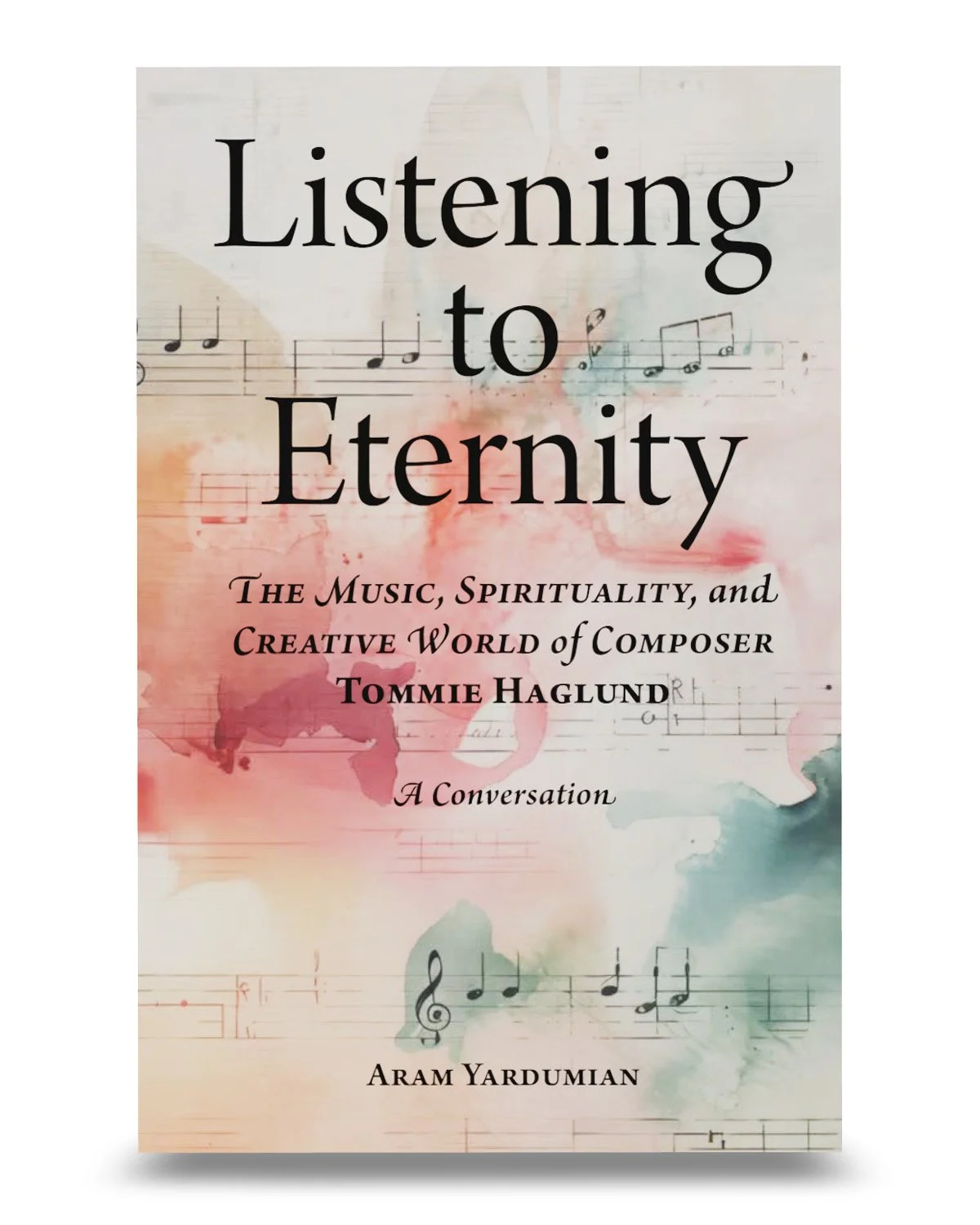
277pp., paperback, $24.95
September 2, 2025
Swedenborg Foundation
ISBN-13: 978-0-87785-366-4
If you could have dinner with six people living or dead, who would you choose? This exercise often serves as something between self-reflection and a conversation starter—a glimpse of someone’s values or interests. The power of music to inspire and fascinate us is apparent in my observation that musicians feature on many hypothetical guest lists. As a musicologist, I would leap at the chance to speak with a long list of composers whose music has deeply affected me, and now and then as a working musician I’ve had the privilege to speak with a living composer about their art and what lies behind it. In Listening to Eternity, Aram Yardumian immerses readers in an intimate conversation with the Swedish composer Tommie Haglund (born 1959), transcribed from recordings taken over meals, late night chats, and even while watching television.
The thrust of the dinner guest game is not so much “who” as “why,” and Yardumian presents readers with ample justification for Haglund’s place on the guest list. Although not yet widely known outside of Sweden, he has received commissions from top-flight ensembles and musicians, won significant awards, and produces art that appeals to classical aficionados and neophytes alike. His music reaches deep into the emotions of the listener, and his interview with Yardumian offers numerous insights into why people find it so compelling.
Haglund himself is on a journey seeking the inspiration behind musical expression. As a young musician he read every composer’s biography he could obtain. No doubt if a book like this existed interviewing Beethoven about his life and music and how they intertwined, it would have been at the top of the list. Yardumian is a fine interviewer, well-studied not only in his subject’s music but in the broader context of influences and peer works, and Haglund offers his private insights generously. Yardumian frequently takes the conversation in the direction I would have myself, and if at times the questions seem to have a particular agenda, it still comes across as authentic curiosity.
Listening to Eternity places Haglund’s music in the context of his specific life experiences. He shares anecdotes from a challenging childhood, struggles with illness and anxiety, the joy and fears of fatherhood, and a single-minded persistence to understand and express his inner emotions through music. Yardumian pursues a mostly chronological journey through Haglund’s oeuvre—a complete list of compositions to-date can be found in the appendix—and ties each piece convincingly to a period in Haglund’s life or to a stage of his artistic development. But the conversation often veers into the natural intimacy of a conversation between friends, plumbing the secrets of abstract topics such as creativity and expression itself, or the role of influences on the personal voice of a composer. The eighteenth-century seer and theologian Emanuel Swedenborg looms large, but so do the English composers Frederick Delius (1862-1934) and John Dowland (1563-1626), alongside a cast of 1970s Swedish musical figures that require footnotes for anyone not already immersed in that time and place. Thankfully, Yardumian provides footnotes throughout, as well as a summary epilogue in which he breaks with the interview format to condense the story into a set of themes and reflections.
For Haglund, spiritual grounding is a source for human connection, and he is also open to new opportunities . . .
The contrasting influences of the vehement humanism of Delius and the profound religious grounding of Swedenborg present a conflict in this story of Haglund’s life and work, but his conviction that there is a deeper meaning to life despite the pain and challenges shines through. The book was originally published in Swedish by the Swedenborg Society in 2022 and is here translated into English for publication by the Swedenborg Foundation. The author’s and subject’s shared interest in Swedenborg is frequently apparent both in the resonance with Haglund’s almost mystical creative process and in the serendipity of specific encounters with people who also claim Swedenborg as an influence. Although Haglund does not want to be thought of as a “Swedenborgian” composer, he has no interest in hiding the influence of Swedenborg on his life and work. For Haglund, spiritual grounding is a source for human connection, and he is also open to new opportunities, such as visiting a medium despite his doubts and wholeheartedly embracing an invitation to a religious ceremony of the indigenous Ojibwe people when visiting Canada.
Throughout Listening to Eternity, I was fascinated by Haglund’s compulsion to express his inner self in his music. This may seem like a given for most composers, but here it is described as the meticulous process of connecting with a spirituality that is both deeply personal and thoroughly relatable. Much of his music grapples with his pain and anxiety, while embracing and resolving it in a way that his listeners can share. “Pain is inevitable,” Haglund states; “Sollievo [a composition title translated as “Solace”] doesn’t mean I’m using anesthesia over myself. It’s about turning away from the bitterness that might have dominated my life.” Elsewhere in the conversation, he shares how his view on seeking the inner self has changed throughout his career: “I used to think maybe I composed to escape reality, but really, no, I’m trying to get closer to it.” The need to express his inner self through music and the joy when he found that others were affected by his music come across as fundamental, childlike in their innocence and immediacy.
Listening to Eternity offers readers a delightful chance to sit in on a conversation between a profoundly mystical musician and an admirer who is able to keep up with the references and broader context of the topics at hand. If I had been there in the room, I would have struggled to keep up, but in the format of a book I could pause to listen to a piece of music that intrigued me or explore a tangent through online research. Aram Yardumian seems more than happy to support Tommie Haglund’s desire to connect with the listener, and beyond the specific topic of classical music, what shines through in this book is the broader journey of an artist searching for genuine emotional meaning and the means by which to express it. Listening to Eternity is a worthy addition to the bookshelf of artist biographies and an enjoyable dive into the creative process of a working composer.

Graham Bier is based in the Philadelphia area where he directs music at Bryn Athyn Cathedral and the Reading Choral Society, serves as a research associate at Bryn Mawr College and lecturer at Bryn Athyn College, and performs as a professional singer. He studied at Oberlin College and earned an MA in vocal performance and a PhD in musicology from the University of York.