“There is a world just inside this one”
A Review of Wonderstudies by David Bailey (Mount Vision Press, 2025)
by Robiny Jamerson
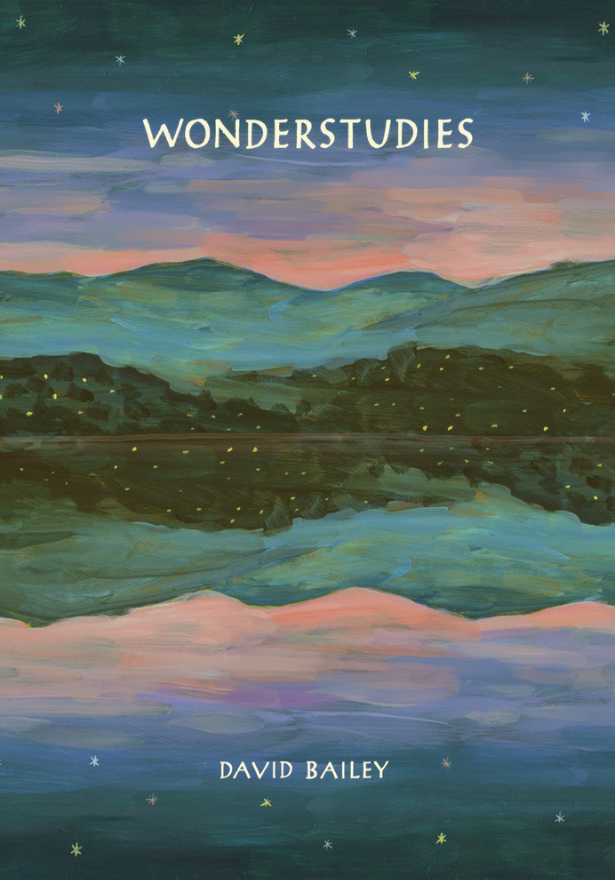
100pp., paperback, $20.00
December 5, 2025
Mount Vision Press
ISBN-13: 978-0996246767
For a poetry collection that occurs primarily along dirt paths, dead-still Sierran hillsides, and campfires, Wonderstudies by David Bailey is anything but solitary. This charming collection is a work of deep communion and a balm to anyone who reads it. Through experiences of unity with the natural world, the human, and the beyond-human, Bailey discovers—and invites readers into—sacred oneness with the infinite mystery of existence. The author’s second book after Journeywork (Mount Vision Press, 2016), Wonderstudies pulses with Bailey’s return to West Marin county, California; the landscape’s wildflowers, insects, waves, and stars show us our way.
The book begins with “Logos,” a poem of creation in which “every creature / [falls] into a dream / of being only itself.” The story of our lives, therefore, is the rediscovery of original oneness. To the question, “Why do we exist?” the poem responds:
I could only say
we must be the mystery’s urge
to wonder over itself, the sun’s longing
to feel its warmth on bare skin, watch
its light fall through the leaves.
Like any work with these stakes, its greatest risk is sanctimony. But Bailey’s balanced, walking-paced verse handles the project with a grace that suits the title, Wonderstudies, bringing together primordial “wonder” and the daily work of “studies.” Even the word “wonder” holds within it two valences: wonder (n) connotes the elemental divine and wonder (v) gives us the childlike, quiet pull of not-knowing. In Bailey’s treatment of the word—“Follow the threads of wondering / into wonder”— the two meanings are time and again one and the same.
Wonderstudies approaches the cosmic through the granular, describing how matter itself is a unified entity. Bailey portrays an ecosystem as “a dozen other creatures / made of each other,” a world in which “Even trees are sidereal, cooled star / grown upon itself like coral / into a stable miracle” (“Elements”). This premise that we are physically constructed of the universe and the universe of us—Bailey credits physicist Richard Feynman’s 1985 book, Surely You’re Joking, Mr. Feynman in the poem’s notes—primes one of the book’s most surprising moves in “Star Summaries”:
Some [stars]
have already burst into
enormous flowers, some coalesced
into worlds around new stars
we cannot yet see. And some may already
be reborn as beings not unlike us.
While I have many times pondered the idea that I am seeing light from a star already long-dead, Bailey’s poem invites me to consider that the star’s elements have already been reborn into something else: that we might somehow perceive life and death at the same time. Or in another way: “lifetimes appear and / disappear like fireflies / in dark woods.” There is great comfort in knowing that we are one flicker within a firefly’s long life.
Despite the vividness of Bailey’s depiction of the natural world, he offers only a few glimpses into the speaker’s human life. There are a few campfires, reports of conversations; there is pain when “my daughter tells me / she misses me,” and a moment when the speaker enjoys “baroque music like a gorgeous robe.” Beyond that, the human moments blend into the symbolic; rather than on characters, the arrow of the poem’s “thou” more often lands on the reader. This made “Cascade” all the more exciting, where the speaker describes a shared encounter with a stranger and a “waterfall” of bougainvillea that results in a moment of triangulated bliss. “These flowers!!! you almost shout,” he writes:
When our eyes
met again, we looked
not at one eye
or the other—each
into each, like mirrors,
on and on.
The universality of the I/thou relationship in Wonderstudies generously invites the reader into “the mirror.” In “Anam Cara” (Gaelic for “soul friend”), Bailey proposes that “In you I can see myself / better than a mirror” and that “the mystery [finds] its face in a forest pool, in / the mirror of a book, / in a moment like this.” The poem itself is a mirror for the reader’s self-recognition, a soul friend.
[Bailey’s] poems reverberate into each other with repeated words, themes, movements, and in doing so embody the “study” of Wonderstudies—the call from the mystery to try again.
Bailey speaks of poetry as “medicine,” and like medicine, this book is best consumed in small, daily doses. Many poems reverberate into each other with repeated words, themes, movements, and in doing so embody the “study” of Wonderstudies—the call from the mystery to try again. Sometimes, these calls are soft: “Gently as a parent wakes a child / for an early morning departure, something / wakes a part of you now.” Elsewhere, they are jarring, as when “Mysterium Tremendum,” after drifting into a self-referential ‘you,’ confronts the reader: “How long / since you saw the moon?” I felt the sensation that I was watching the world through its reflection in the speaker’s upturned eyes—until those eyes turned onto me and I no longer saw the sky, but the reflection of myself.
I’ve loved carrying Wonderstudies with me as spring has started its return, as it has urged me to feel my shared mystery-blood with the buds and birds as they appear. Recently, on a barely warm evening as the sky turned pink, I saw a fingernail of moon rising above a rooftop. I paused for a moment, feeling a tiny glow of wonder. That was the last time I saw the moon. How about you?
Robiny Jamerson is a poet and writer living in Chicago, Illinois. She holds an MFA from Columbia University and is a recipient of the Bennett Poetry Prize from Academy of American Poets and Edward Eager Memorial Prize from Harvard University. Her work can be found in Image Journal, Foothill Poetry Journal, No Contact Mag, Poets.org, and elsewhere.