Permeable Devotion
A Review of The Natural Order of Things by Donika Kelly (Graywolf Press, 2025)
by Darius Stewart
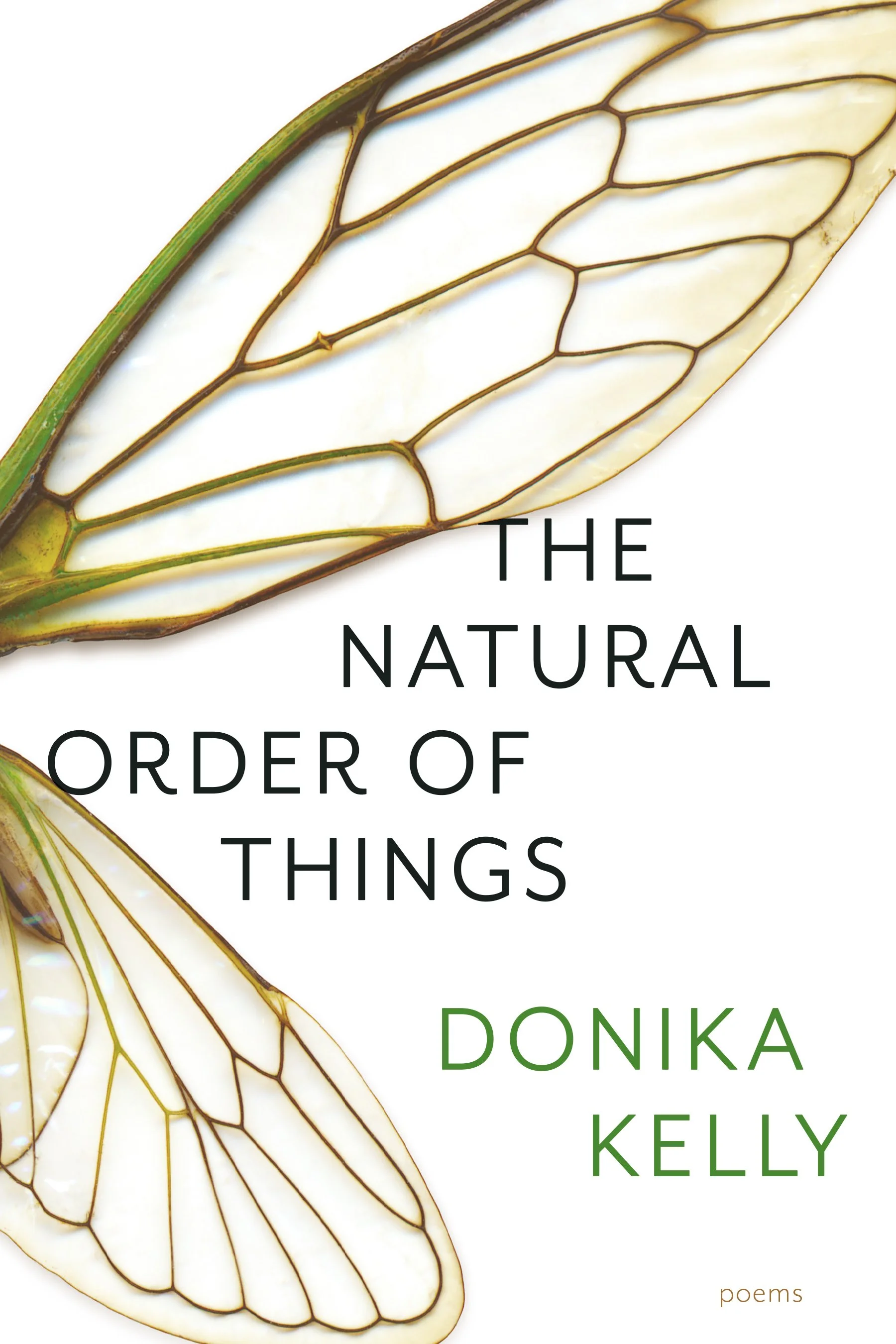
72pp., paperback, $17.00
October 7, 2025
Graywolf Press
ISBN-13: 978-1644453599
Reading Donika Kelly’s The Natural Order of Things is like inhabiting a house that has weathered a series of heavy storms—the windows are still intact, the floorboards are worn smooth from years of use, yet there is a calm, lamp-lit hush in every room. Kelly poses a question that feels like the very air we are breathing right now: How do we live wide-awake in a world so clearly wounded without losing our capacity for tenderness? She doesn’t offer the easy comfort of a bandage. Instead, she offers the steady hand that holds the light while we confront the damage together. These poems move through memory and the body with a composure that feels deeply grounded. It’s a spiritual book in the way a garden is spiritual: messy, rooted in the dirt, and stubbornly persistent. Kelly anchors her readers in tactile reality, where the sacred is not located in a cathedral but in the domestic hum of “the old fan pushing air hot as my own skin / and the blood besides.”
Kelly’s poems continually explore the boundaries between a person and a creature, between the lover and the beloved, between the person we were and the person we’ve become. She reminds us that to be “permeable”—to truly let the world touch us—is to risk being changed by what we love, to shoulder the “shadowed ship” of kinship through the currents of history. But in her hands that danger also reads as grace: not naïveté, but a willingness to keep choosing connection—to trust that tenderness can still endure in a world that hasn’t always been gentle. She recognizes that what we can offer one another is “a gift that binds,” a world where, “grateful, I say / our names in both the shadow and the light.”
The title itself feels like a challenge. “Order” usually suggests something neat, settled, inevitable. Kelly’s “order,” by contrast, is something negotiated daily amidst the wreckage of “red dirt” and “Arkansas backwoods”—a fragile balance between grief and pleasure, instinct and care. The collection doesn’t read like a lecture on how things are; it reads like a field guide for how to live among the ghosts of our pasts and the living creatures in our yards with integrity intact. That integrity is clearest in the book’s refusal to look away: having “stayed with the body, with the bones,” even when history is something that “could gut you like a hog.”
Kelly doesn’t give us answers or easy resolutions. Instead, she reminds readers that spirituality isn’t solely the province of the “beyond”…
If you come to the book seeking the sacred in the ordinary, Kelly meets you there. She doesn’t rely on religious vocabulary to evoke reverence; she discovers reverence by looking closely. Animals, bones, and the way light settles across a kitchen table become sites of prayer because the poems treat the everyday as consequential rather than incidental. That commitment also lives in the texture of her diction. When Kelly shifts from the scientific and polysyllabic “mandible” to the communal music of “Jaw // Y’all,” the poem turns in the mouth: the language moves from the clinical to the intimate without apology, as if insisting that precision and kinship can coexist in the same breath. The result is a poetics where a “ditch lily,” a “Jeep parked haphazardly,” or an inherited vernacular cadence becomes not just scenery but a register of devotion—proof that the pedestrian is where the spirit is tested and transformed.
The poems of desire are vital to this vision of the transformation of spirit. Kelly treats the erotic not as spectacle but as a mode of knowledge—a way of perceiving and being perceived. To want someone is to encounter the holy reality of another person’s vulnerability without collapsing the limits of the self. In the heat of intimacy, she finds a grounding peace: “when I am inside you, / I am no longer tumbling but an animal / base and humming, free / from the conceit of reason.” Here, embodiment is not an obstacle to meaning; it is one of meaning’s primary instruments.
Ultimately, The Natural Order of Things resonates because it refuses to separate beauty from responsibility. The poems are musical and lush, but they remain accountable to the “red field in which I stood but barely survived.” Kelly doesn’t give us answers or easy resolutions. Instead, she reminds readers that spirituality isn’t solely the province of the “beyond”—gods, heavens, or transcendence. In her poems, the sacred is found by looking down and inward rather than up and away. To be “spiritual” in her world is to treat the heat of a fan, the persistence of a roadside flower, the weight of bone and inheritance with the kind of reverence one might reserve for a holy relic; this is the collection’s quiet instruction. Kelly invites us to see that the red dirt—the field in which she “stood but barely survived”—is both potting soil and the “hole / I’d made in myself,” the “torpor” of being buried alive, and yet delight in knowing “Spring is coming.”

Darius Stewart is the author of Intimacies in Borrowed Light: Poems (EastOver Press, 2022) and Be Not Afraid of My Body: A Lyrical Memoir (Belt Publishing, 2024), which was named a 2025 Stonewall Book Award–Israel Fishman Non-Fiction Honoree and a Lambda Literary Award finalist for Gay Memoir/Biography. His essays have appeared or are forthcoming in Arkansas International, Brink, Bat City Review, Brooklyn Review, Colorado Review, Fourth Genre, and Salamander, among others, and received a Notable Essay distinction in Best American Essays 2022. He lives in Iowa City with his dog, Gizmo.