The Still-ness of Space
A Review of Lost Cities by Valencia Robin (Persea Books, 2025)
by Jessica Hudson
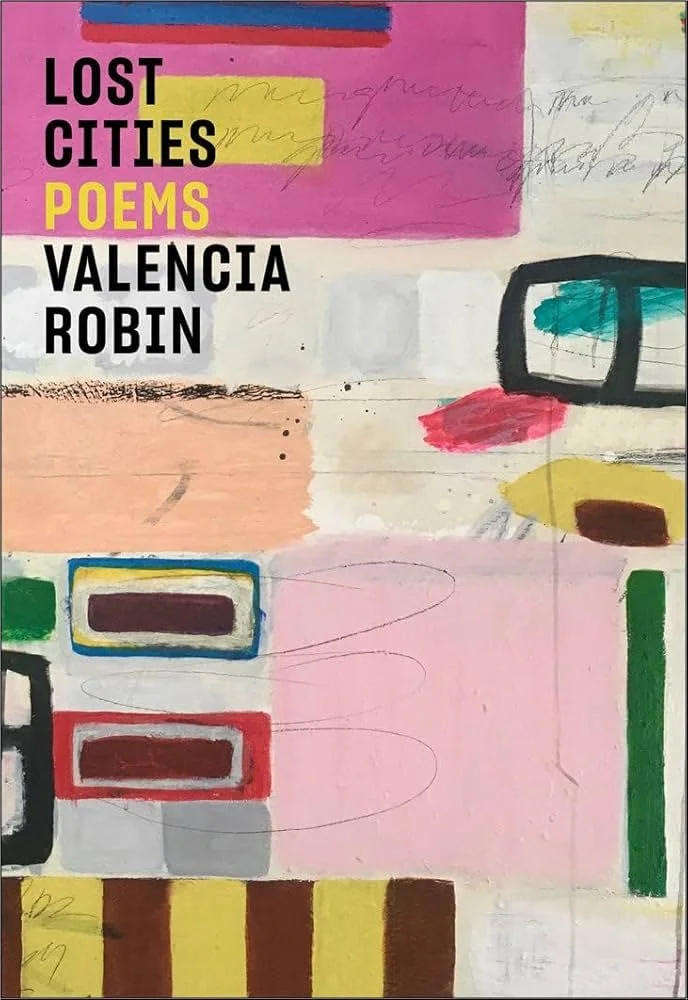
55pp., paperback, $17.00
August 5, 2025
Persea Books
ISBN-13:978-0892556151
In her lyric hybrid collection Quiet Night Think, Gillian Sze shares William Carlos Williams’ definition of a poem as “a thing made up of . . . words and the spaces between them,” and asks, “What is this space that poetry offers?” Sze answers: “Creative space. Emotional space. Reflective space. A space for possibilities . . . [T]o gain it, you have to lose something. Loss . . . is what provides the space from which meaning can emerge.” It is just this space that creates the wholeness of a poem, the fullness of its meaning. By coming into being, a poem holds space for what has been lost and is a space of reflection and possibility.
Valencia Robin’s 2025 collection Lost Cities realizes and describes space twice: once in “Woke,” as “everything there is to know yawns into you / and you into it . . . / . . . as simultaneous and endless as space” and again in “After Graduate School,” in which “this space between sunrise and sunset, / ask if she’s ever managed to get inside it,” into that space-time we all live in that still slips through our hands so easily (“uncertain / and necessary as water,” Audre Lorde chimes in from the epigraph page).
Throughout the three parts of Lost Cities, space is relative to meaning which for Robin comes from trees, dogs, books, mountains, the news, Star Trek, and the knowledge that every thing in which she finds meaning is predicated on loss—personal, national, political, physical, quotidian. What is lost is said, held, shared, kept, remembered still, because it is here in her poems. In “Poetry,” Robin uses the word still ten times, in nearly every other line, a word that evokes a dual sense of ongoingness and unmovingness. This still-ness initiates the essence of loss that permeates and sustains Lost Cities, but Robin won’t name it stillness until “Driving home,” in Part Three, while listening to the news during a global pandemic and wondering what it is “that lifts me out of that inferno, / sets me down inside this respite, this startling stillness.”
Robin begins Lost Cities by taking readers on the “First Walk of the New Year,” and part One meanders through eighteen more poems inhabited by trees, books, and several dogs. The people in them are dear: a grandmother, an unknown brother, Audre Lorde evoked as a lifeboat (“there are all kinds”), even strangers passing on the street. Each of the first nine poems are comprised of a single stanza—each held like a single stone in the cupped palm of the page—until “New Day,” when the lines link arms as couplets, keeping each other company, affirming that “whatever reality is or isn’t, / at least you’re not in there by yourself.”
Still, these poems integrate and evoke specific losses: “your sons and daughters / one of whom did not come home”; “fathers missing / in action”; “my mind a little lost”; “every gone hour, disappeared year / refusing to be”; “each new sighting just a reminder of what we’ve lost.” But, as Gillian Sze affirms, loss “provides the space from which meaning can emerge,” and Robin does not leave her readers or herself-as-poet to float untethered in the space of these losses and injustices. Rather, she propels into the joy missed at the start of Lost Cities, when during her New Year’s walk, she rolled her eyes “as if love was a second job, as if joy could wait.”
In Part Three, Robin side-eyes the COVID-19 pandemic while trying to find a kinder dreamscape beyond the inescapable and overwhelming confines of her house, her car, video calls—“anything not to think about the news,” she begs in “Non-essential Worker.” The natural landscapes and neighborhood walks from Part One are now absent or inaccessible, so she finds ways to expand her senses while keeping her distance: in the sound of brothers hitting baseballs next door, a thumbs up from an old woman in the vaccine waiting room, an assortment of trees with “wide, open arms,” and “the urge to make something.” While on “Zoom,” she imagines “our gorgeous, combustible bodies / humming, swaying, touching, craving, / delighting, savoring—the kind of technology / that takes millions of years to perfect.”
Charlottesville, Atlantis, and elegy. Every one of us lives in at least one of these cities . . .
The first epigraph to Lost Cities comes from Elizabeth Bishop’s poem “One Art” and reads: “I lost two cities, lovely ones.” The two cities invoked by name are Charlottesville, “ground zero / . . . the shore / where those first stolen Africans landed,” and the lost city of Atlantis, “a reminder of what we’ve lost” and metaphor for all we live for and with: “how could it all disappear, /yet feel as if it’s just around the corner?” In “Song,” Robin alludes to a third city: “No one / my age should willingly come to this lost city,” the city of—“No, don’t call it nostalgia . . . / . . . Call it elegy.” Charlottesville, Atlantis, and elegy. Every one of us lives in at least one of these cities: a real city that has, at one time (centuries, decades, years, minutes ago) lost itself to injustice; an imagined “lost” city that by its very nature can only to be found in stories; the metaphorical lost city of our own past, its streets packed with stores of emotions alongside towering buildings that scrape the present.
At the epicenter of these three cities, comprising the whole of Part Two in Lost City’s structural triptych, is “Lt. Uhura, Communications Officer, Star Trek.” Uhura has lived through times of violence against people of color, the storied intrigue of the unknown, and the past itself, starring in the original Star Trek series over half a century ago. Through five poem-episodes, Robin-as-poet-as-Uhura (yet another triptych) asks, “How many ways can I translate /. . . the distance between things?” The distance between the past and/as the present. The distance between the personal and/as the political. Between the quotidian interactions and natural settings of Part One, and the technology-based communications and isolated pandemic arrangements of Part Three.
But she—Robin, Uhura, both, the same—does it. In “[EPISODE 3: FIRST KISS, 1968],” a poem about, at first glance, the first interracial kiss on television when “Kirk and I locked lips,” Robin-Uhura doesn’t shy away from what really matters. Here, in the middle poem of the middle section of Lost Cities is the list of their names, each one suspended like a star in the galaxy of the page, each life given its own space, its own orbit, as if they all “lived in some galaxy far, far away”:
George
Breonna
Ahmaud
Sandra
Tamir
Michael
and Trayvon
As if we will never stop searching because we know this planet we live on—every lost city, injured, imagined, remembered—isn’t the only one in the universe. As if this isn’t the only place and way to live, the way we have lived for years and years, our shared history of separation and stillness. As if Uhura will always be in the ship’s bridge, channels open “[beyond the beyond],” hailing frequencies, reaching the unreachable, ready to respond. It’s “almost as if you opened a channel / and something came through, a voice . . . ”
Jessica Hudson (she/her) currently lives and libraries in Albuquerque. Her work has been published in DIAGRAM, New Delta Review, Quarterly West, and elsewhere.