
The Language of Dance: Ballerina Dorothy A. Rogers-Walker
in Conversation with Christopher Honey
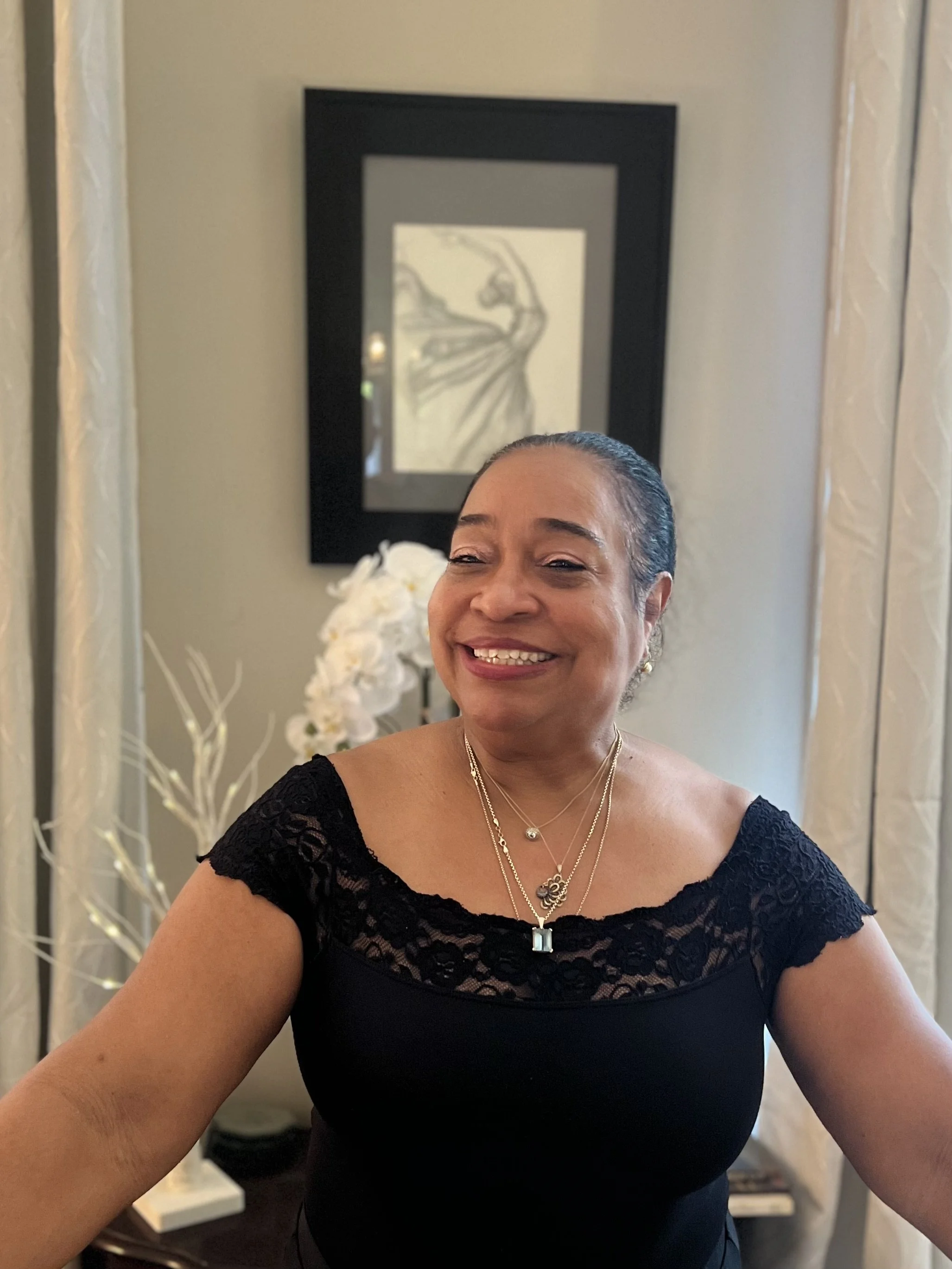
Dorothy A. Rogers-Walker is a classically trained ballerina and the artistic director of St. Mark’s Dance Studio, where she has been a dedicated leader since 1983. She began as a substitute teacher and choreographer and now leads the studio while continuing to teach ballet and pointe.
She trained at the Dance Theatre of Harlem and performed with Point Park University and the Capitol Ballet through the Jones-Haywood School of Ballet. She also served as Ballet Mistress for the St. Mark’s Dance Company in Prague.
The following transcript has been edited for length and clarity. A version of the conversation can be found in the audio interview above.
Christopher Honey: Could you tell us a little bit about your background?
Dorothy Walker: I teach ballet and have been teaching ballet at St. Mark’s Episcopal Church for a little over 42 years. I’ve taught creative dance to young children. Since I have been there. I have served when St. Mark’s had a dance company, which was founded by Mary Craig Hill, who actually brought liturgical dance to St. Mark’s Episcopal Church. So, for right now, I am the artistic director and studio manager of St. Mark’s Dance Studio on Capitol Hill.
I was introduced into ballet at a young age of about six, seven years old, inside of a Catholic church. There was a woman named Catherine Duffy who was just starting off a dance school. During that time, many new entrepreneurs went around to different Catholic churches trying to get students to come in. This school was located inside of a church, Incarnation Dance, and the church is Incarnation Catholic Church on Sheriff Road.
Now I grew up here in Washington, D.C., from immigrant parents from Trinidad and Tobago, and two blocks away was a dance studio. But my parents didn’t send me there. They literally drove me to the other side of D.C. to take classes: ballet, jazz, tap, pointe. It was just wonderful, and I grew into that up until the age of thirteen, when I needed a break. I was bored, I was tired. So, I took a year off from dancing, and then I realized that was so much a part of me that I needed to get back into dance. I was being exposed to yearly recitals at Spingarn High School here in DC, and I was involved with DC Parks and Recreations. So I was performing to large crowds and very comfortable.
In the world of ballet was something that I found very relaxing, and it probably was being raised Catholic, and you’re listening to very secular kind of music, very calming music. It just seemed to make sense. And so, while I was ready to enter high school, ballet was at the forefront of my thinking all the time. Ballet was the starting point, really, for me.
CH: You started learning in a church, and you now teach in another church, and you also talked about liturgical dance, how the founder of the St. Mark’s dance studio did liturgical dance, and you, yourself, have choreographed it. Can you talk about that experience?
DW: Liturgical dance had become quite popular back in the late ’60s and early 70s. Mary Craig Hill had a studio in Arlington, Virginia. The pastor at that time of St Mark’s Episcopal church asked her to come over and introduce liturgical dance to some of the members there, give them the structure that they needed. She had a background in ballet, but it was kept quite quiet, as her father was a Supreme Court judge, and at that time, you just did not dance. I think after his passing, she found her freedom.
Liturgical dance was being expressed in St Mark’s Episcopal Church, blended into the actual service. At the same time, on the Catholic side, liturgical dance was also being used. So many churches that they were actually using dancing as part of another way of getting the message across from the scripture reading, or the Bible reading. And today, they call it “praise dance.” It is a freedom where many women, of many colors, of many body types, have the freedom to want to praise and worship the Lord through dance.
CH: Teaching in an Episcopal church, preparing dance for actual church services, and just from your own experience learning inside a religious environment — how does the sacred space affect dance?
It is a replacement for words. That’s what dance is. You should have that inner feeling and expression when you hear the music and there are really sometimes no words.
DW: It was something that I literally had to learn. And I think because my parents were from the islands, they did not have a connection to the traditional Black African American Baptist style of singing, the vocals, the words, or their experience. So, I always felt I wasn’t quite grounded into the Black community because I wasn’t getting that experience. I was just a good little Catholic girl going to an all-girls Catholic High School in Bladensburg, Maryland.
What actually happened was, in high school, I had auditioned to take more advanced classes, and that exposed me to more feelings, African movements, but at the same time, securing the foundation of ballet. So, I started in high school really bridging the ballet foundation, and taking that experience and putting it more into interpretive dance. I started learning from my teachers this style of interpreting dance. It is a replacement for words. That’s what dance is. You should have that inner feeling and expression when you hear the music and there are really sometimes no words.
CH: In some ways, traditional dance, ballet, sounds like that actually helped connect you to an African American spiritual tradition because, being from a Caribbean background, you weren’t raised in that tradition. Is that correct?
DW: That is correct. On Sunday after our dinners at home, my father would put music on, but he had the Spaniard flair, so flamenco and castanets. Castanets were my first instrument. I was also living in Washington, DC, where that was not the case for many people. So what I did was remain quiet and just learn. Because dance really saved me, but it also exposed me a great deal. Ballet was just my strength. I was very slender, and I had excellent teachers and was awarded the opportunity to study in New York under Dance Theater of Harlem with Arthur Mitchell and Karel Shook. These were prominent men who wanted to make sure the community of ballet was being shared among those of color. [Mitchell and Shook] were just opening up a school, and I just happened to stay with my brother in New York for the summer and take those classes for the Summer Intensive under Dance Theater of Harlem. The classes were packed with students because they were hungry for ballet, but a lot of them could not handle those eight hours of pure ballet or pointe work and the demand and discipline that it warranted, and they left. If you’d been there since June, by August the classes had whittled down to a solid 25 students who made it through with the intentions of, “Where do you go from here?” And for me, it was on to college to further my ballet language and understanding. So, with Arthur Mitchell, [there was] no liturgical dance. It was strict ballet.
CH: Could you tell us about your career in ballet as a professional ballerina?
DW: I had a wonderful opportunity, a full scholarship to NYU, which I turned down, because I was not ready for the real world in the ’70s;. To live in New York and commute, it was hard enough commuting from Brooklyn to Harlem. I was just completely underexposed to being in the community. I was picked up from an all-girls’ Catholic High School, was taken to ballet classes, picked up, and so forth. I had not migrated with a lot of the people here in Washington, D.C.. However, my instructors knew that I was turning down an NYU full scholarship. They looked at me as a dancer and forgot my background. I ended up with an audition at Point Park College, which is now Point Park University in Pittsburgh, Pennsylvania, went up, auditioned, was accepted, and continued my dance training. And it actually insulated and solidified my ballet because my teachers were Russian and Dutch, and they did not, at least not to my knowledge, see color. There were a lot of other students.
But color became much more noticeable upon performing. Because the real world then said, if you’re going to do a traditional white ballet, not white in color, but white of purity — Swan Lake is a white ballet, La Slyphide is a white ballet — the Europeans would say it was only meant for white people, not for anyone of color.
I think the rude awakening of my sophomore year in college was when I was told I could not perform in Swan Lake because I would upstage everyone. My makeup needed to be as white as possible with the pancake [makeup]. And I could get it as light as I could with my skin, but it was only so much. And at that time, my instructor, my ballet teacher, said I could not perform. [I said,] “But you don’t understand, my parents are coming to see me. You guys gave me a scholarship. I’m en pointe. This is wonderful. I live and breathe it. Never miss classes nor rehearsal.” I was denied [the opportunity] to perform, but I wouldn’t stand for that. So I went to the dean, who came to watch me in class and rehearsal, and stated that I would be given that opportunity to perform because I was under scholarship, and I was just as good as someone else, and maybe they should give me the Black Swan [role] that was reserved for juniors or seniors. The teacher had no choice but to allow me to perform. And for me being, I guess, obstinate, or going forward, back in the ’70s, I was to receive an F for my school year because I defied and went to the dean. So, I received an F in my college transcript for the entire school year in dance.
CH: That’s a painful lesson in both advocating for justice and feeling the wrath of those who like things the way they are.
DW: Correct, and that is why it did not stop me. I did perform that night. My parents saw me. My younger sister said all she remembers is that someone said, “Oh, she can’t perform because she’s brown, and she hasn’t lightened her skin enough.” And that’s all my sister remembers. She says, “I remember they just said you couldn’t do it because of the color of your skin.” And I’m thinking, what an interesting thing for a younger sister, five years younger than me, to have to experience, and while she was in high school. This was something she didn’t think existed. It never occurred, but it became much more prominent, and it was fine; I performed, and will never forget that. That is why the choreography of dance and ballet remained. Some of my classmates who came from Philadelphia, who were Black women, left. They couldn’t perform and it is because, unfortunately, some of those teachers would go right to their face and let them know “your lips are too big,” “your behind is too big.” So they felt really out of sorts, and their love for ballet left, and so they changed their majors, and they eventually left the university.
For me, it was an awakening getting an F. Then I injured my knees in the next performance, and my parents said, time for you to pack your bags and come back to DC.. So I had a choice. I did come back to DC.. I did see a doctor [with the Redskins football team], because we didn’t have physical therapists like we do right now. But I also had the choice to either stop ballet and never do it again, because I might have been bitter, or just to keep going forward. And I kept moving forward because of my love of ballet. But I also made a pact that I would ensure that every child I taught would never need to worry about the color of their skin. So, I’m constantly reassuring all my students, your skin should not matter, your body type should not matter.
CH: I wonder if you could talk about how your own personal spiritual practices have been influenced by dance, and how your dance has been influenced by your faith.
Someone has words, someone is playing the music, and the third component, like the Trinity, is to actually dance and be given that expressiveness.
DW: I think, well, I know for one thing: my faith is definitely strong, and I know that as an artist, I’m grounded in my faith. I could not do what I’m doing right now without walking the walk that has been given to me in my faith as a Catholic teaching in an Episcopal Church. We’re doing the exact same thing; we are dancing for Jesus. We are there presenting. Someone has words, someone is playing the music, and the third component, like the Trinity, is to actually dance and be given that expressiveness.
For children who may not realize, that there are certain dance steps that are actually words. Raising your arms up is actually showing the strength to God. Folding your fingers is having to be in that place of solitude. There are certain steps in liturgical dance that are common across many other dance studios But not too many are practicing that anymore; it’s kind of fizzed out. And I needed to come back into the community to allow not only my dancers, but also adults who want to express their faith in dance to be performed, not just for the recital, but for certain times of the year, such as when we walk into Ash Wednesday.
CH: And locally, I know that St. Mark’s is well known for its social justice ministry, but there’s also an artistic community around it. What is it like, being part of the artistic community around this church in Capitol Hill?
DW: St. Mark’s is an Episcopal Church, but I view it as a church for the community. They recently welcomed the monks to come in and eat and rest lst Wednesday.
CH: These are the peace monks? The Buddhist monks, who traveled across the United States to Washington, DC.
DW: That is correct, from Texas all the way. Their journey was to the Capitol, and we are very nicely placed just two and a half blocks from the Capitol. The Buddhist monks who walked from Texas found their way into St. Mark’s. Our church, it’s a peaceful church, it’s a safe church to walk in, and you are open to express your religion. So yes, social justice is very important, because if we do not help others, what are we doing for our community? We’re not doing the work as a Christian.
CH:It does seem like that you are working hard to create a safe space for your students to explore dance and explore their own spiritual and artistic practices. Well, thank you so much, and we may have to talk again once this liturgical dance program takes off at St. Mark’s.
DW: Well, I’m hoping to build it back, so it will be part of the readings, the gospel, or especially as we enter Easter. There’s just so much that we are entering — we have Ramadan, we have Ash Wednesday. Religion is the guiding light, and my job is also to ensure that not only are my students peaceful, but they also know how to find their inner peace for themselves and through dance, it’s really important. So I’m proud of my students, and I look forward to seeing them.
CH: Thank you so much.