
My Writing Meditation
by Pico Iyer
Editor’s note: When I heard Pico Iyer and Thomas Hübl speak together on the Point of Relation podcast, I invited Pico to share his contemplative practice, and I also began to ponder, what do I do in my life contemplatively? I invite our readers to choose some daily practice you are already doing in your life and begin to view it in this way over the coming days and weeks. — Deb Baker
Every morning—it’s been forty years now—I wake up early, often before first light shows through our windows, and make an eight-foot commute to our dining-table. Slowly, unfailingly, I prepare two pieces of toast and three cups of strong tea and consume them. Then I walk a further fifteen feet or so—our $500-a-month apartment here in suburban Japan has only two rooms—to the desk I shared for years with our daughter, when she was of an age to plaster it with pictures of Brad Pitt and Hello Kitty.
There’s a window to my left, but the streets outside are silent even after everyone’s woken up. There’s clutter all around, but one small open space in front of me. For five hours, as the light changes and I travel across a hundred worlds, as my wife heads out for swimming and pages fill up with my barely-legible black scrawl, I write. Or, on every other day, sit in a state of acute frustration, bored, tired and distracted, but determined to sit here for three hundred minutes and, since no words are coming, simply do background reading, fact-checking, nothing at all.
There’s no computer in the room, and though Brad Pitt and Hello Kitty are staring down at me, I hardly notice them. Instead I sit and sit until I feel I can hear a voice deeper than my own, an “inner voice,” perhaps, that’s wiser than I will ever be. Or unexpected words start streaming in on me—this doesn’t happen often—and then I just transcribe them, being written as much as writing.
The hope is to see something beyond my many projections and ideas. To get out of my mind and come back to my senses. To register something I (and maybe a reader) can touch and see and smell because the world is always going to be more interesting than my thoughts about it.
As I’ve been doing this full-time since 1986—I’m a freelance writer and have no other way to support my loved ones—I’ve come to know the contours of the day (and of my mind) quite well. I know, pretty much to the minute, when I’ll be most alive and when most droopy. I know if one day is electric, the next one will be dead, though the one after that will be alive again. I need no soft bell as in a meditation-hall because I can tell, by the texture of my thoughts, when ninety minutes have passed and exactly when the three hundred are up.
I do everything by hand—I never learned to type—and I don’t really mind what comes out of my five hours of sitting still. I’ve learned to read my weather—how overcast I am, the likelihood of rain—more reliably than the light outside, by whether I sing in the shower, and how often I race off to fortify myself with cookies or chocolate.
I know that meditation practices—and yoga and the like—are invaluable medicine, open to anyone, of any background or orientation. But I’ve never been tempted to try anything more than my daily walking meditation for my mind because I feel my three hundred minutes at my desk are not so different. When friends ask if I’ve ever meditated, my poor wife rolls her eyes and says, “All he ever does is sit there!”
What emerges from the process is always going to be less important than the process itself. For me the beauty of my writing meditation is that it allows me every morning to stroll into an invisible cabin in the woods and just sit still. Preparing for the noisy world to come. Clearing my head. Trying to make sense of all I’ve experienced and felt—or simply to embrace the non-sense of it all.
Aspiring, quite often, to see the world as my wife sees it, or that stranger on the way to the post-office, or that boss who regards me as a fool. And the more the world accelerates, grows faster and more furious and loud, the more grateful I am for my homemade zendo. Often I’m not sure how I could ever stay anchored and constant and joyful without it.
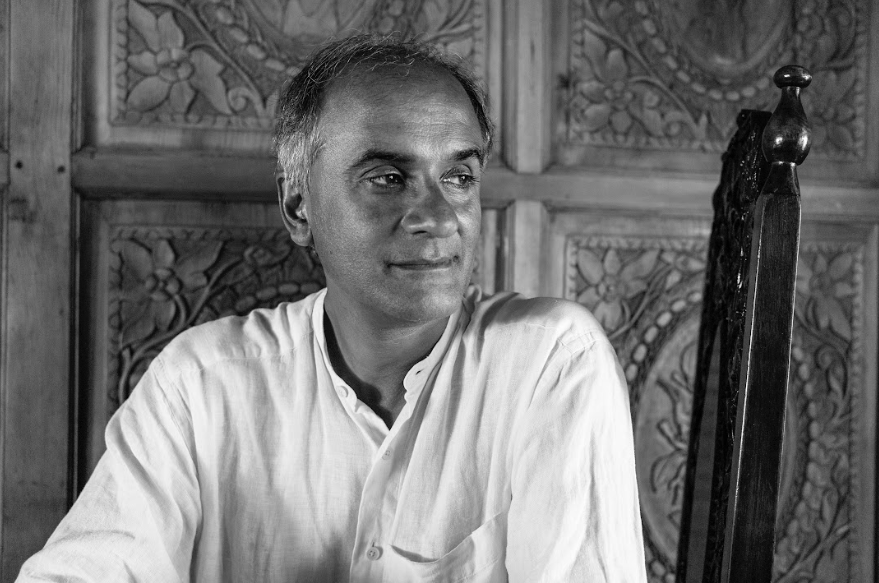
Pico Iyer is the author of 17 books, translated into 23 languages, including The Lady and the Monk, The Art of Stillness and, most recently, a work about silence, monasticism and wildfire, Aflame.