
“A kind of tribute to what we are”
A Review of Reading Genesis by Marilynne Robinson (Picador, 2025 [US]; Virago, 2025 [UK])
by Rachel Grandey
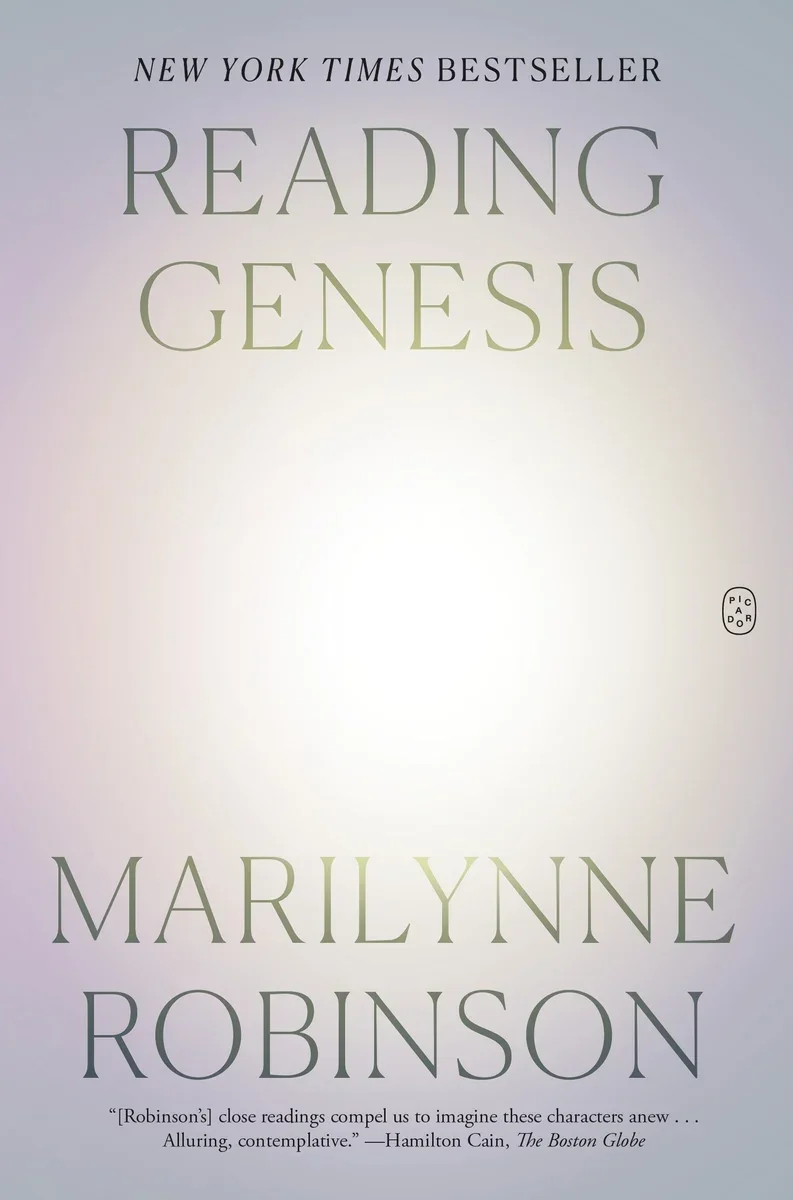
352 pp., paperback, $20
Hardcover release: Mar. 12, 2024
Farrar, Straus and Giroux
Paperback release: Mar. 25, 2025
Picador / Virago
ISBN: 9781250371850
Novelist and essayist Marilynne Robinson has built her decades-long literary career on close readings of the numinous, everyday grace of humanity. In Reading Genesis, Robinson undertakes a close reading of the Genesis narrative that is thematically on familiar ground. There is much that is recognizable to those who have read any of Robinson’s other work: the gentle, resolute voice with its intellectual (but never scholarly) and unassuming (but always authoritative) appeal; the intertwining of theological meditation with the dirt-under-fingernails nitty gritty of human experience; the cradling of the individual within universal themes; the capacity to hold events up to the light and play with them like jewels, revealing hidden shadows and glinting new perspectives; and the measured, stately insistence that truth must be chewed on and mulled over.
Reading Genesis is a 230-page interpretation of the first book of the Bible, with the entirety of the King James Version’s translation tagged on at the end as a kind of epilogue. It is Robinson’s most ambitious project yet, because here she makes the nature of the Divine and the Divine’s relations with creation her direct focus. Perhaps as a result of the weighty subject-matter, it is preachier than her novels, which present the urgent demands of empathy against the relentless impossibility of judgement. In Reading Genesis, humankind is judged. “We are Lamech and we are Noah. Unlimited or misplaced vengeance pervades our societies under the name of justice and always has,” she informs us early on.
Robinson is keen to communicate, relentlessly at times, that the writer(s) of the Genesis narrative actively built upon existing literature from the surrounding cultures in order to mark the uniqueness of their God. This God, who created out of nothing for the sake of a good creation itself, conceives of people as neither incidental nor innocent, loves and forgives beyond human imagination, and brings destiny from terrible (and deeply relatable) human moral decision-making. “That human beings were so central to the Creation that it would be changed by them, albeit for the worse,” she writes, “is, whatever else, a kind of tribute to what we are.” Her thesis is no more nor less than that all these stories mean something, that they speak, if we hear them, of who we humans are and who we should be.
In defence of this thesis, she traces strands of grace, forgiveness, and redemption from their earliest iterations in the Bible. She reminds us again and again that humanity has great capacity for good and evil, but that God’s covenant faithfulness depends on God alone. She turns questions on their heads, such as Abraham’s conversation with God about the destruction of Sodom, which “elicits a scriptural statement about the nature of God – not that He would spare the righteous in punishing sinners but that He would instead spare sinners in protecting the righteous.” Through comparison, allusion, and illustration, Robinson highlights the wonder that is the divine choice to speak to and through humanity. In the process she offers insights into what it means to be made in God’s image and held in God’s blessing.
Her thesis is no more nor less than that all these stories mean something, that they speak, if we hear them, of who we humans are and who we should be.
Along the way, Robinson also follows individual, human narratives as vital exemplars of massive divine themes, tracing blessing where it may be found. She shows us the value of the “beautiful detail,” for example, in God wanting to share the pleasures of morning and evening with Adam and Eve and in the tribes of Israel being “first of all the pride and comfort of a sorrowful woman.” I was moved by Robinson’s evocation of emotion throughout her meditations: Cain’s crying out; Rebekah’s bitter disappointment with Isaac; Joseph’s brothers’ prolonged agony over what they have done; God yielding “to His love for the incorrigible” which is Absalom, the Prodigal, all of us.
Reading Genesis is an impressive work, blending literary and theological studies in Robinson’s own luminous prose. Her evident joy and strength is in the literary traditions from which she draws. She notes literary techniques, offers new readings of words such as vengeance and abomination, and leans into comparative narratives and contemporary parallels, notably the Enuma Elish Babylonian creation myth. In the process she reads the Genesis narrative as a collection of clever referential theological parables, a self-aware “counterstatement” to other creation narratives in which humans are accidental products of a cosmic battle between divinities. Human value and culpability (particularly in the creation and flood narratives) are, she argues, what set Genesis apart from other ancient iterations of those stories. In comparing Babylonian sacrifice with Jewish sacrifice, she also addresses ritual practice that is pleasing to the Hebrew God only insofar as it is about community, welcome, and justice.
Reading Genesis is just that: a reading. It manages to keep hold of theology without being bogged down in it, but it is not a work of systematic theology. It can appear uneven, disconcerting, and even disorienting in places. From its first sentence, launching in with “The Bible is a theodicy” (that is, a defense of God’s ways in the light of evil and suffering), it has a breathless feel, leaping on a whim from the Sunday-school summary for any less Biblically literate readers to detailed theological considerations. Some readers might find its structure and lack of chapters jarring as it moves abruptly across a patchwork of stories and themes. But I am reminded that Genesis itself is higgledy-piggledy, messy, with the air of having been stitched together yet making one cohesive whole. This style can make it all the more intimate. Perhaps that’s partly the point. This ambling nature of Robinson’s observations gives the book the feeling of a fireside monologue. We can indulge the occasional digression because the writer shares such wisdom and beauty with grace and generosity. As a reader, you want to lean in to savor the wisdom. For the gift of her perception alone, Robinson’s latest book is worth reading.
This is a book you could savor a couple of pages at a time as a kind of devotional (as I did), or gobble up in huge chunks on a long train journey (as I also did). It frequently demanded a response: a looking-back at my own Bible, a reconsideration and reframing, a mulling-over and chewing-on. Robinson describes Genesis as “a spectacular burst of light without antecedent but with a universe of consequences.” While the theology that shines throughout Reading Genesis is not orthodox in any sense of the word, and it could certainly have done with a tighter edit, it doesn’t miss that burst of light. And crucially, it does not allow the reader to miss the light either.

Rachel Grandey is a UK-based doctoral researcher in Extinction Studies, exploring religious perspectives around environment and culture in South East Asia. Her writing has featured in Agape Review, Amethyst Review, Paper Dragon and Monk in the World. She can be found on social media as @RachelGrandey or at rachelgrandey.wordpress.com.