Divining the Past: Poet Chinua Ezenwa-Ohaeto
In Conversation with Christopher Honey
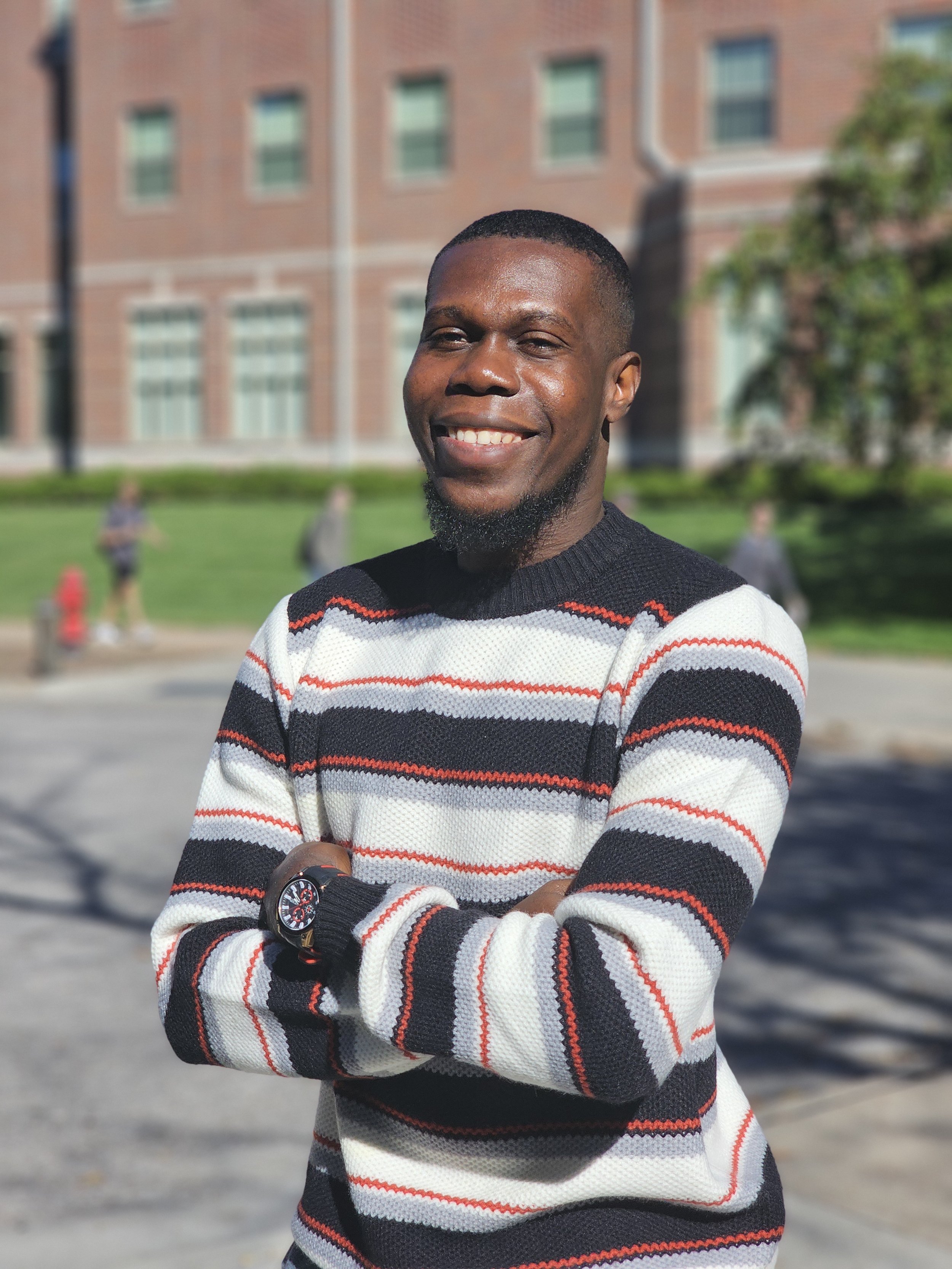
Chinua Ezenwa-Ohaeto lives in Lincoln, Nebraska. He is the author of The Naming (University of Nebraska Press, 2025). His works have appeared or forthcoming in American Poetry Review, Transition Magazine, Massachusetts Review, Joyland, Oxford Poetry, and World Literature Today.
The following interview has been edited for clarity, flow, and length. An unedited version of the conversation can be found in the audio interview above.
Christopher Honey: I’m here with the award-winning poet Chinua Ezenwa-Ohaeto, who’s going to talk to us about his practice, his spiritual practice and literary practice. Chinua you’re in the US right now, in Lincoln, Nebraska, but you’re from Nigeria, is that right?
Chinua Ezenwa-Ohaeto: Nigeria has thirty-six states, and I am from the eastern part of the country, specifically Imo State. However, I grew up in Anambra State, which is about two hours away from Imo by road, depending on traffic.
One thing I love about the United States is how people identify where they are from. For example, even if someone's parents are from Texas, if that person was born and raised in Lincoln, they will often say they are from Lincoln. One thing I love most about that approach is that, because you are from a place, you feel a responsibility to contribute to its development and progress. In my case, it is a bit more complicated. My parents are from one state, but I grew up in another. As a result, the state where I grew up does not fully recognize me as one of its own because my family originates from elsewhere. People may see you as [an outsider] simply because your roots are in a different state. That is one of the complexities of identity in Nigeria. Still, I love Anambra State. I grew up there, and it has been a wonderful place for me and an important part of who I am.
CH: That is an interesting difference.
CEO: Yes, we often identify ourselves by where our parents are from, and that is valuable in its own way because it helps us know our ancestry, our roots, and the history of our people. It gives us a sense of connection and belonging. For that reason, many people maintain strong ties to their ancestral homes. During most holidays, families travel back to where their parents are from, especially their father's hometown or village. In that sense, our identity is closely connected to our family lineage and place of origin.
CH: Well, I think that gets back to one of the themes that comes up a lot in your poetry, and that is the question of where you’re from and who your people are. I gather that it's connected to some particularly Nigerian spiritual practices. How would you describe those? And can you tell us a little bit about how it’s affected your poetry?
CEO: Yes, I am Igbo, an ethnic group in Nigeria. We are primarily located in the eastern part of the country. We [reveres] our ancestors—those who came before us—because we believe they continue to contribute to our lives and progress. This does not make them gods. We have a Supreme God, and we also believe in a personal spiritual force known as Chi. My name begins with C-H-I, and many Igbo names either begin or end with "Chi" because of the importance of this concept in our culture. Now, the Chinese people call it qi, right? Yeah, qi, the essence, but the Igbo people call it chi, the same pronunciation, but with C-H-I. [Qi is pronounced “chee,” and reflects the spelling using Pinyin, the current standard romanization system for Mandarin Chinese.]
We [revere] our ancestors because we believe they guide and support those who come from their lineage.
Chi is often understood as a personal spiritual guide that intercedes on one's behalf before the Supreme God, whom we call Chukwu Okike. I explain this to show that, in Igbo cosmology, the realm of the ancestors is far below that of the Supreme God. We revere our ancestors because we believe they guide and support those who come from their lineage. Having lived through life's challenges, they are thought to possess wisdom that can help their descendants navigate similar difficulties. There are different ways to connect with them. One can do so on a personal level, or through a spiritual specialist known as a Dibia. The term is somewhat similar to "doctor." Just as there are doctors for the eyes, heart, or legs, there are Dibia who specialize in spiritual matters. Even within that tradition, there are different types of Dibia, but in this case I am referring to the Dibia Afa, a diviner.
A Dibia Afa helps connect a person to their spiritual essence and ancestral lineage. Through divination, the Dibia may communicate messages about what the ancestors desire, what they advise against, or how they may help the individual. Engaging with this spiritual realm requires a particular kind of energy, which I refer to as spiritual force. There are rituals and procedures involved, but one can also honor the ancestors through simple acts of reverence and acknowledgment.
An Igbo person may begin the day by speaking to the ancestors, then to their Chi, and finally to the Supreme God. Common items used in such prayers include dry gin as an offering and nzu, the white chalk associated with purity. They then address their Chi, asking for intercession and support, before concluding with prayers to Chukwu Okike. In this way, a person begins the day with the assurance that they are not alone. I should add that practices vary across different parts of Igboland.
Another way of connecting with the ancestors is through a Dibia. The seeker brings certain items, which the Dibia specifies beforehand. During the divination process, the Dibia may use an instrument known as the ugili (afa ugili) to interpret spiritual messages and discern hidden matters. The seeker is asked to touch the instrument and recite specific words. Through this process, the Dibia seeks to connect with the person's past and ancestors. If the ancestors wish to communicate, they do so through the Dibia. Likewise, if the seeker wishes to address the ancestors, the Dibia serves as an intermediary. The purpose of this encounter is to seek understanding and possible solutions to life's challenges.
CH: So you’ve talked about this sort of divination process through the doctor, but it does seem to me that in your poetry, you use that as a form of divination as well. Can you talk about how your poetry has been impacted by this kind of spirituality?
CEO: Yes, we believe strongly in spirituality, and we do not necessarily see death as an absolute ending. We believe that an ancestor can return to life through reincarnation. A person may die, and when a child is later born into the lineage, people may observe similarities and conclude that the ancestor has returned in that child. Sometimes this belief is based on physical resemblance—the child may look remarkably like a great-grandparent, grandparent, or parent. In other cases, it may be associated with birthmarks, where similar marks appear on both the deceased person and the child.
People may also identify reincarnation through mannerisms or personality traits. For example, if a person was a poet during their lifetime and a descendant later displays the same gift and inclination, some may see that as evidence of reincarnation. It is important to note that there is also a spiritual dimension to this belief. Families may consult a Dibia, the spiritual specialist I mentioned earlier, who can use divination to determine whether a particular ancestor has indeed returned. Through this process, the Dibia may confirm what the family suspects and provide further insight into the relationship between the ancestor and the living descendant.
CH: Well, you kind of hit upon something that I would love to talk about. You are following in a particular ancestor’s footsteps. Your father was also a poet and your father’s no longer with us. How did it impact you to follow in the footsteps of a well-known poet and become a poet yourself?
CEO: It can be challenging at times. I remember when I was growing up and had just started writing. I won an award that brought me some recognition in the Nigerian literary scene. Later, I entered another competition but was not successful. Afterward, one of the readers, judges, or organizers commented online that they had expected more from me. My name is Chinua, and I bear the name of one of our literary giants, Chinua Achebe. My father, Ezenwa-Ohaeto, was also a writer. The comment suggested that, given my name and literary connections, I should have produced something [more remarkable]. That bothered me when I saw it, but I was still very young. I think I was around twenty-one or twenty-two years old. What can one [reasonably] expect from someone at that age who is still learning the craft of writing, especially in a language that is not even his first? No one should expect a twenty-one-year-old writer to be who he will become years later.
I know I have grown tremendously since then and become much better at what I do, but I could not have been the writer I am now at twenty-one, even if I had been a genius. Genius itself requires time and development to fully manifest. So it has been challenging. In Nigeria, people often compare me to my father, Ezenwa-Ohaeto. While I understand where that comparison comes from, it can sometimes place expectations on me that overlook the fact that every writer must grow into their own voice and pace.
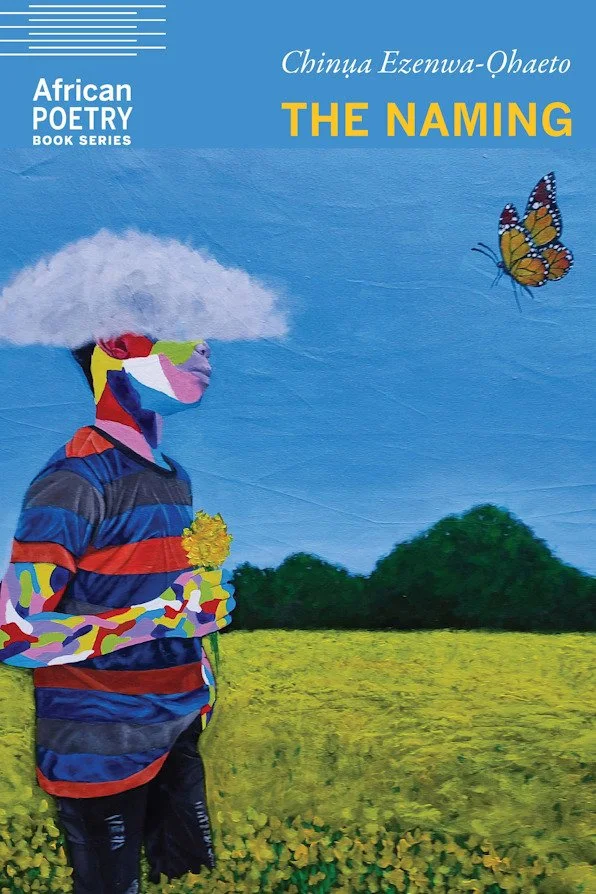
CH: You talk about the name your father created by being a well-known poet, and you also mentioned you share the same first name as the Nobel Prize-winning novelist Chinua Achebe. And your first collection is called The Naming. There’s got to be a story there.
CEO: The Naming is my first collection. In the first poem, I am speaking with my ancestors and telling them about the things that have been disturbing me in my personal life. I name the things that have been bothering me, my worries extending to the issues of my country and where I am at the moment. So I speak to my ancestors and say, “Hey, you were here before me. These are the things that I am going through, and I don’t know how to sort them out. Please help me.” I started naming all these things from childhood in Nigeria to my adulthood: these are the things I went through as a kid, these are things I went through as an adolescent, these are the things that are happening to me as a Nigerian, and these are the things that are happening to me as an adult, as an immigrant.
CH: You write about politics back home, and some of the things I’ve heard in your poetry can be hard to hear about. Tell us a bit about it.
CEO: I was speaking with my friend on the phone yesterday, and I told them that since I was born in Nigeria, I have never had two months of peace—waking up and everything is fine, with no bad news, nothing sad, no killing, no death. It has never happened. Every day there is sad news. Beyond the killings, corruption, and incongruities happening in my country, there is one incident that disturbs me the most. A government official was called to account for how he spent money that was given to him. He came before the panel to give an explanation and faked fainting just to avoid accountability. If a government official can do that, what do they expect of the citizens they are governing?
Another time, not even 10 years ago, money went missing. When asked about it, an official told the country that rodents came into the office and swallowed the money—swallowed millions of naira. It was received almost as normal; people laughed about it. The way I saw it, this official showed no regard for the people he was governing and no respect for the citizens. It says a lot about a country and its leadership. It felt like he was indirectly calling the citizens stupid with what he said. How do the world and other countries see us? When officials do these things, they think it has no effect internationally, but it does. It affects us now.
Imagine coming to the United States—how would they believe what I tell them? We are from a country where officials lie to us. It has an effect. And the people, because they are already tired due to ongoing crises, often let things go. It is not that we are stupid; it is that people are exhausted from suffering. People are tired of all these things. They let it go because they do not want more problems or danger. It does not mean that we are stupid. One thing I know is that when people can no longer take bad things anymore, they react. The reaction, I know, is always enormous.
CH: You’re naming these things—naming a lie, naming corruption—but also naming in a positive way.
CEO: Yes, I also have to call names. Even when I am naming the problems, I have to call names. I listed my ancestors. I listed the places, the names of the towns where these things happened. Even if a name is not in the title, it is somewhere in the poem. I am naming these things so that we do not forget, because people tend to forget easily. I do not want us to forget. Luckily for us—or perhaps unluckily—we have a presidential election coming next year. People are asking how we move forward, yet I still see some Nigerians supporting the current government and wanting to re-elect them. I am tired of all these things. The question I ask is this: These government officials travel to other countries. They come to the United States, Britain, and France. They see how things are done and how systems are managed. Then, after enjoying all these things abroad, they return home and mismanage everything. It is very sad. That is why I keep naming these things in my poems. I want them to be documented. There are also many wonderful poets doing this in their own ways.
CH: The poems in your collection, were they mostly written in Nigeria, or were any written here?
CEO: Yeah, that’s a wonderful question. Most of them were written when I was in Nigeria, but about 15% of the collection was written in the United States.
CH: Did you feel that helped to have that distance from there? But also, do you feel a separation from these names and the ancestors being over here?
I don’t feel that Nigeria is something you can leave behind, because it follows you everywhere.
CEO: I don’t feel that Nigeria is something you can leave behind, because it follows you everywhere. No matter where you are on earth, your country follows you.
Currently, in the United States, I can’t even travel home because I’m a Nigerian, because of the ban list, the visa processes, and everything involved. So it follows me everywhere; I can’t even avoid it.
Another thing is that my family is also back home. So no matter where you are as a Nigerian, it follows you. It is my identity, and we have had to work hard to make it better for ourselves. And that is what saddens me the most—that I think we are not even doing enough, but I am doing it in the best possible way I can. I talk about Nigeria, my past; I take it everywhere. I call out names, however possible. I talk with my friends, I write essays, I write poems, to make people aware that this is not how we are supposed to be. This is not the state we envision for ourselves and for our future.
CH: So you said you’re not able to go back to Nigeria right now, is that because of what’s going on over there, or are things happening here in the United States?
CEO: For me, it is mostly about what is happening in the United States with immigration, not what is happening back home. Back home, Nigeria is very big, and what happens in one part of Nigeria should affect everyone else. It affects me because if I keep quiet, what happens in another part is like a seed— it keeps spreading, and if I think, “Oh, it is not affecting me, it is not happening on my side of the country. Everything is fine.” With time, it will catch up with me. So, I don’t have to wait until it gets to me before I react. That is why all of us are reacting now, to cope with all these issues that we are having. So currently, it is not about what is happening back home, because I go home every year. It is about the immigration processes in the United States. We are among the 39 countries that are banned—no visas are being renewed, and no visas are being issued.
CH: So, if you were to, you know, go back home, you would struggle to come back to finish your PhD. You’re doing your PhD in literature, is that correct?
CEO: Yes, I go home every year, so this is one of the years I am stranded. By now, I am supposed to be home; this time last year I was home. Every year since I came here, I have always gone home to see my family.
[Communication] is complete when the speaker and the listener are able to talk.
CH: What is your focus in your studies, working towards your PhD in literature at the University of Nebraska?
CEO: I love research so much. So The Naming is about ancestry and my connection to my ancestors. I remember telling you about the medicine man—what we call the spiritual man who connects you to your past. One thing I will say about communication is that it is complete when the speaker and the listener are able to talk. I talk to you like we are doing now: I talk to you, you listen to me, and you respond. That is when communication is complete. But in The Naming, the communication is not complete, because I was speaking to my ancestors, but they did not speak back to me. It ended where I said, “I have said everything I want to say to you, my ancestors, my father’s fathers, please direct and redirect me.”
Now, in my dissertation, I am working on a collection where my ancestors speak back to me, and I did that through the medicine man. In that collection, I went to a medicine man—we call him Dibia Afa. I said I wanted to speak to my ancestors and hear what they think about me, my life, and how I should go forward. So we performed the incantation as the process requires, and then my ancestors spoke back to me through this medicine man. That is what my dissertation is about: my ancestors speaking back to me.
CH: How do you complete the dialogue when someone is not there?
CEO: The ancestors can speak to you in many ways, but I will mention three. The first way is through dreams. You sleep, and your grandfather or a man you once saw in your family photo album appears and begins communicating with you. That is one way. The second way is that they can inhabit one of your relatives’ bodies and speak through them. Finally, as I mentioned before, there is the medicine man. When he is speaking, you will know it is your ancestor. It is like going to a doctor who wants to communicate with your ancestors. He performs the required processes and incantations. While he is speaking, you recognize that it is not the doctor speaking. He becomes possessed, and he begins to speak with the mannerisms of your ancestor. If it is your father, you will know it is your father.
CH: I would definitely encourage everyone to check out The Naming. Certainly, I have felt some wonderful dialogue. I felt held accountable by reading your poems. Hearing about this, and just the way you’ve incorporated these very important spiritual practices into your literary practice, and your doctoral studies as well.
CEO: Yes, and one thing I will add is that being away from home, from my personal perspective, can alienate one from their ancestors. So we believe that the land is powerful. Where your bare foot stands connects you to your past, your life. Now, when you are away from it, it is difficult to connect to them, to your past, to your ancestors, and to all these things. You will know that you are not fully connected by traveling and moving away from your homeland. You will feel it, but it does not mean that they are not with you. They are still with you. It is like a phone network: when the signal is strong, you have five bars, but when it is low, you have two bars. It is the same way you feel it, like the bars have reduced, like your connection has dropped a little.
CH: Oh, that is a melancholic but important note to end on. But I’m glad you still have two bars left. Thank you so much for speaking to me, and for sharing about your spiritual practices, your poetry, and some of the history of your people in Nigeria.
CEO: Thank you, I’m grateful.