
Cloud Study
by Daniel Cooperrider
Words about clouds are clouds themselves.
– Mark Strand, 89 Clouds
Today is Ash Wednesday, the beginning of Lent, a liturgical season that takes its name from an Old English and Germanic word for lengthen, as in the lengthening of the day’s light we notice this time of year. “From earth you have come,” one of the pastors of our church will say to me this afternoon as they smudge the sign of the cross on my forehead in ash and oil, “and to earth you shall return.”
For the last week, as February turned to March, a procession of days with cloudless skies and strong winter sun melted the blanket of snow, leaving only a few scattered heaps like abandoned boats beached at low tide.
With the snow gone, the landscape is holding its own Ash Wednesday service through the seasonal ritual of remembering itself as earth, with the neighborhood grounds re-donning their tawny, desiccated greens and soggy, clay browns.
Overhead, it’s as if the snow blanket that was here has been lifted, flipped, shaken out, and re-made as a stratus cloud in the sky. It is not a flat white, but a mottled, topographic alabaster, like a cracked teacup stained with touches of the snow’s soft blue and dove gray tenebrae.
The sky seems to be both light and dark at the same time, glowing and dimming. The light appears directionless, spread evenly across the horizon.
Stratus, from Latin meaning “layer,” is the lowest cloud type, capable of settling at ground level as fog, and rising to a maximum height of only 7,000 feet. These are the clouds that skyscrapers and mountains rise above like islands, as in German Romantic painter Caspar David Friedrich’s Wanderer above the Sea of Fog.
Sitting with the cloud today, it’s hard to imagine an upper limit to it. It’s as if the sky has forgotten its usual sky-and-cloud dynamic and is all a sheet of cloud. Without my focused attention, it almost disappears, its shapelessness giving it a vacant feel, but when I open to it, and foreground it, it is immersive and has a feeling of the infinite and the boundless.
It feels close enough to grab, and like if I were to reach out to it, there would be nothing to hold onto—no structure, no center, no edge.
It feels close enough to grab, and like if I were to reach out to it, there would be nothing to hold onto—no structure, no center, no edge. In cloud guidebooks, stratus is often described as featureless. It is more apt to say that it is diffuse, indefinite, and ambient.
Stratus can seem insubstantial, spectral, and otherworldly, but as the first returning red-winged blackbirds of the year trilling in its mist remind me, the moisture from the cloud is substantially nourishing and integral to the season.
At first it can appear static. Studying the point at which the tops of the neighbor’s cottonwood branches end and the cloud begins, the swift, steady movement of the cloud becomes apparent. The entire sheet is scrolling en masse, right to left like Hebrew script, west to east as I face south, countercurrent to the sun’s arc. The way it moves suggests an action of being pulled ahead, like a window blind being raised or lowered by a pulley system. When I key-in to its movement, it becomes the dynamism of the landscape—a quivering aliveness of oppositional but not opposed energies and affects.
Clouds are the verbs of the day’s grammar.
From many mornings sitting in this spot I know that I am facing the sun, but right now I cannot see it, nor glean any hints that might help me locate it. This prompts a disorienting sense of being adrift or disjointed from place and time.
Not being able to see the sun troubles our long-sensed correspondence between sky and time, an alliance we see in sundials and Stonehenge and zodiac calendars and can hear in English words like temporal and tempest, and in French le temps and Spanish el tiempo—words which can mean both “time” and “weather.”
By clouding our vision, clouds allow us to see.
In veiling the sun, the particular stratus I am contemplating today is Stratus nebulosus opacus. If the stratus were a bit thinner, as it could be this afternoon after some of the fog burns off, it would have a different ambience. Stratus translucidus is the only cloud type that lets us gaze directly at the sun and see the sun’s shape without damaging our eyes. In this way, stratus can both conceal and reveal the sun to us.
By clouding our vision, clouds allow us to see.
No wonder that contemplatives and mystics have long enlisted clouds as phenomena of nature uniquely apropos to the project of encountering and expressing the nature and mystery of the divine.
Written in the mid-fourteenth century by an unnamed English monk, The Cloud of Unknowing counsels the novice seeker not to pursue God through intellectual striving and knowledge, but through sitting with the impossibility of knowing God. By embracing the opacity that is between us and God, we stay closest to God when we stay close to the cloud. “This darkness and this cloud will always be between you and God, whatever you do,” the author writes. The spiritual task is imagined as that of making one’s home or setting up one’s tent in the cloud. “Stay there as long as you can, crying out to God over and over again because you love God. It’s the closest you can get to God here on earth, by waiting in this darkness and in this cloud.”
The author of the Cloud doesn’t pursue a relationship or spiritual practice with clouds beyond the metaphorical, although if they did I imagine they’d have a fondness for the type of stratus that keeps its hold on today. Engulfed by this formless, directionless, spectral cloud that feels at once everywhere and nowhere, stratus sets an apophatic, unknowing mood to the day. While I can look at pictures of other cloud types and remember their personalities—the calligraphic whimsy of cirrus; the ebullient, noble summons of cumulus—the thoughts and feelings that gather and settle under today’s cloud blanket have a particular flavor and feel to them—tensive and contemplative, settling and unsettling, enigmatic, eerie, suggestive of the incomprehensible, rendering a chiaroscuro of meaning and mystery.
[Clouds] are the ultimate art, available to all, every day, free of charge.
“Nature is a mutable cloud,” wrote Ralph Waldo Emerson, “which is always and never the same.” He called clouds “the daily bread of the eyes,” and “the ultimate art gallery just above us.” Clouds are among nature’s most radically egalitarian invitations to pause for beauty and awe, and to meditate with them as emblems of the cosmos in its momentary, ever-changeable guise. They are the ultimate art, available to all, every day, free of charge.
Clouds can be found and felt not just everywhere outdoors but throughout indoor art galleries as well. English landscape painter and plein air pioneer John Constable referred to clouds as the “key-note,” and the “chief organ of sentiment” in any landscape painting. In his cloud studies from Hampstead from 1821 and 1822, Constable painted over one hundred small canvasses in which he liberated landscape painting from the horizon and turned the gaze outwards towards the clouds and the sky. Stratocumulus were his favorite subject, with their churning, billowing, tectonic veracity and emotional immediacy. On the back of the canvases he included meteorological notes, including the time the painting was started and the time it was finished. Often a painting took about an hour. Constable called his cloud practice “Skying.” “Painting,” he wrote in a letter about these pictures, “is but another word for feeling.”
Christopher Tilley, in The Materiality of Stone: Explorations in Landscape Phenomenology, writes: “The painter sees the trees and the trees see the painter, not because the trees have eyes, but because the trees affect, move the painter, become part of the painting that would be impossible without their presence. In this sense the trees have agency and are not merely passive objects.” When we look at Constable’s clouds, we see the painter seeing the clouds, and we see and feel the clouds seeing and moving the painter. We see the agency and the animism. We feel the emotion. We merge with the mood.
“I can be jubilant one moment and pensive the next,” Bob Dylan once said in an interview, “and a cloud could go by and make that happen.”
In addition to the correspondence between time and the sky, a third strand of meaning is braided through clouds. From the Latin temperare we get temper, temperature, and temperament: disposition, weather/sky/clouds, and mood. What if these three layers of meaning and experience are something more than etymological kin? What if they are folded together as a unitive experience, or as three expressions of a shared dynamism and choreography, as with the classical Christian trinitarian formula for God, and similarly with water itself, which is what clouds are and which is the only substance able to exist on earth in the three modes of solid, gas, and liquid?
[Clouds] invite us to ponder and to feel how we and the clouds—and by extension ourselves and the world—find ourselves tethered and tuned in a shared, extended atmosphere of aliveness.
Alfred Stieglitz made the correlation between clouds and moods the theme of his Equivalents series. Started in 1923, Equivalents consists of over 300 photographs whose subject matter is the clouds. With this series Stieglitz ushered in a modernist turn in photographic art. À la Constable, most of his cloud photographs lack reference to the horizon, and he would often mount them sideways or upside down. Without an orienting anchor, the images hold our gaze through the emotive resonance we feel with the clouds themselves. They invite us to ponder and to feel how we and the clouds—and by extension ourselves and the world—find ourselves tethered and tuned in a shared, extended atmosphere of aliveness.
Stieglitz began turning his camera to the clouds in response to criticism of his earlier work by Waldo Frank. Frank suggested that the power in a Stieglitz picture was due to the charisma and hypnotism that the artist held over his subjects, as in his portraiture. Challenged by this, Stieglitz decided to make the sky his theme, attempting to photograph that which was beyond his ability to influence. In photographing clouds, he quipped, he was photographing God.
Near the end of her life, Stieglitz’s wife and by-then widow Georgia O’Keeffe painted her own cloud studies, her Sky Above Clouds series. In part these were inspired by the new perspective on clouds that commercial airplane travel made possible. Here we see the clouds from above, each a small island, a puff, but together they form a field, and the field forms the skin and exoskeleton of the planet. In these paintings, much like with any photograph of the planet taken from outer space, clouds are earth’s outerwear and camouflage, earth’s jewelry, makeup, and hair. Clouds are earth’s flourish, earth’s mood, earth’s aliveness.
The artwork that today’s stratus most reminds me of is Agnes Martin’s The Islands I– XII. This work consists of twelve large canvases that are intended to be exhibited and seen in order. When entering the gallery, they all look like large white canvases, almost identical, with only subtle variation in tone. Each canvas has between four and twelve horizontal sections alternating white and off-white. The first canvas has five white bands striped by four off-white bands. The second canvas has three off-white and two white, and so on. The experience of moving through these paintings is like sitting with a stratus cloud—immersive, bewildering, with the light from the canvasses quivering with a glowing-dimming dynamism. As one moves through them one moves through tension and release as ideas and patterns develop and repeat, with variation. Like snowflakes. Like mycelium. Like trees. Like rivers. Like clouds. Like breathing. Martin compared her paintings to music. “People are not aware of their abstract emotions,” she said, “which are a big part of their lives, except when they listen to music or look at art.”
In the philosophical tradition of phenomenology, moods are not a secondary, subjective addition to our existence, but are a primary, foundational connective tissue between us and the world. We always find ourselves in one mood or another, whether it be ecstasy and enchantment or lethargy and boredom, and each mood is revelatory in its own way, making the world known to us in a certain way and under a certain hue. There is no such thing as a mood-less way of being, no such thing as an independent, rational, non- feeling, objective experience. Our relation to the world is always and already tuned to a certain tone and pitch and timbre, set from beyond ourselves, or from the interface of the way the world meets us, and the way we meet the world.
What if our emotions don’t belong to us, but to the landscape, to the cloudscape, to the planet?
We can tend to think of moods and emotions and anxieties and traumas and joys and ecstasies as being inside each of us as distinct individuals, as psychological phenomena. But what if emotion, mood, and thought are more ecological than psychological? What if these experiences don’t exist inside, but in-between—in the interstitial, the relational, the ambient, the atmospheric? What if our emotions don’t belong to us, but to the landscape, to the cloudscape, to the planet?
“Emotion is not ours,” writes philosopher Bayo Akomolafe. “It’s not a brain phenomenon, it’s a territorial phenomenon and it enlists bodies in how it comes to matter.”
What if it wasn’t the mystics that enlisted clouds in their theology, but the clouds that enlisted the mystics?
We are not below the clouds. They are not beyond us. We are in them. They are in us.
The stratus greets the ground underfoot as fog, chills the cheek as mist, and humidifies our lungs through each breath we take.
We are always-already participating in the formation and reception of clouds. Clouds are seeded by us and by other telluric phenomena. Pollen and fungal and plant spores that are in the dust we kick up as we walk through the neighborhood, or as we dance and sing for the rain to come act as nuclei for water droplets to condense around, which is how clouds start to form. The water we drink and the liquid in our bodies is, ultimately, a passing gift on loan from the clouds.
When, in the first chapter of the book of Acts, Jesus ascends into heaven, he is described as departing the earth into the clouds, and when he returns it is said that he will return in the same way that he left, coming back to the earth from the clouds. This echoes the way of things here on earth, and the way of clouds in particular—clouds gather and disperse, they accumulate as nimbostratus, and dissipate as a wintry mix of rain, sleet, and snow. They gather again as high cirrus mare’s tales and as anvil-shaped cumulonimbus thunderheads, and they disperse again. This is a planetary testimony to a type of salvific and renewing power that is not eschatological, but ecological and hydrologic.
Clouds are water droplets dancing in the sky before they traipse down hills and valleys as streams and convene as rivers and lakes. Sometimes they freeze solid and pose as ice, even as they swim as perch and crappie below the ice, and as they steam when the thermos of hot chocolate with peppermint schnapps the ice fisher brings out onto the frozen lake during this, the last week of the ice-fishing season, opens for a sip. And as the ice fisher breathes out into the cold, condensating air, the water droplets dance themselves back into little cloud puffs again.
“Clouds are the source of water,” councils the Vedic hymn “Mantra Pushpam.” “The one who knows this becomes established in themselves.”
“Water is the source of clouds,” the hymn counters. “The one who knows this becomes established in themselves.”
Although I didn’t notice the exact moment when it started to happen, today’s stratus has started to thin. I still can’t see the sun, but I can see a dreamlike glow coming from where it has moved to while I’ve been sitting here for the last hour or so. There is still no edge to the cloud, no center, no shape, and the contemplative tension and ambiguity of it remain, even as the glow of the sun has brought with it a feeling of release and a sense of momentum and mutability, like a chord progression.
It conveys the feeling of snow melting, of icicles dripping on the porch: the deliquescence of winter.
For now, my makeshift tent of attention is set up as close to the clouds as I can get.
Feeling what the clouds feel, we can feel what the planet feels, and we can feel ourselves as the earth that we are, and as the earth to which we shall return. What could the planet need and want from us more than to feel and to be and to become along with it, in attunement and alignment with the way of things?
In enlisting us into the mood and meaning of the moment, clouds bring us close, maybe as close as we can get, to the now of God on earth.
This essay is included in Live Each Season as It Passes, forthcoming May 1, 2026, from The Pilgrim Press, copyright ©2026 Daniel Cooperrider. Used by permission.
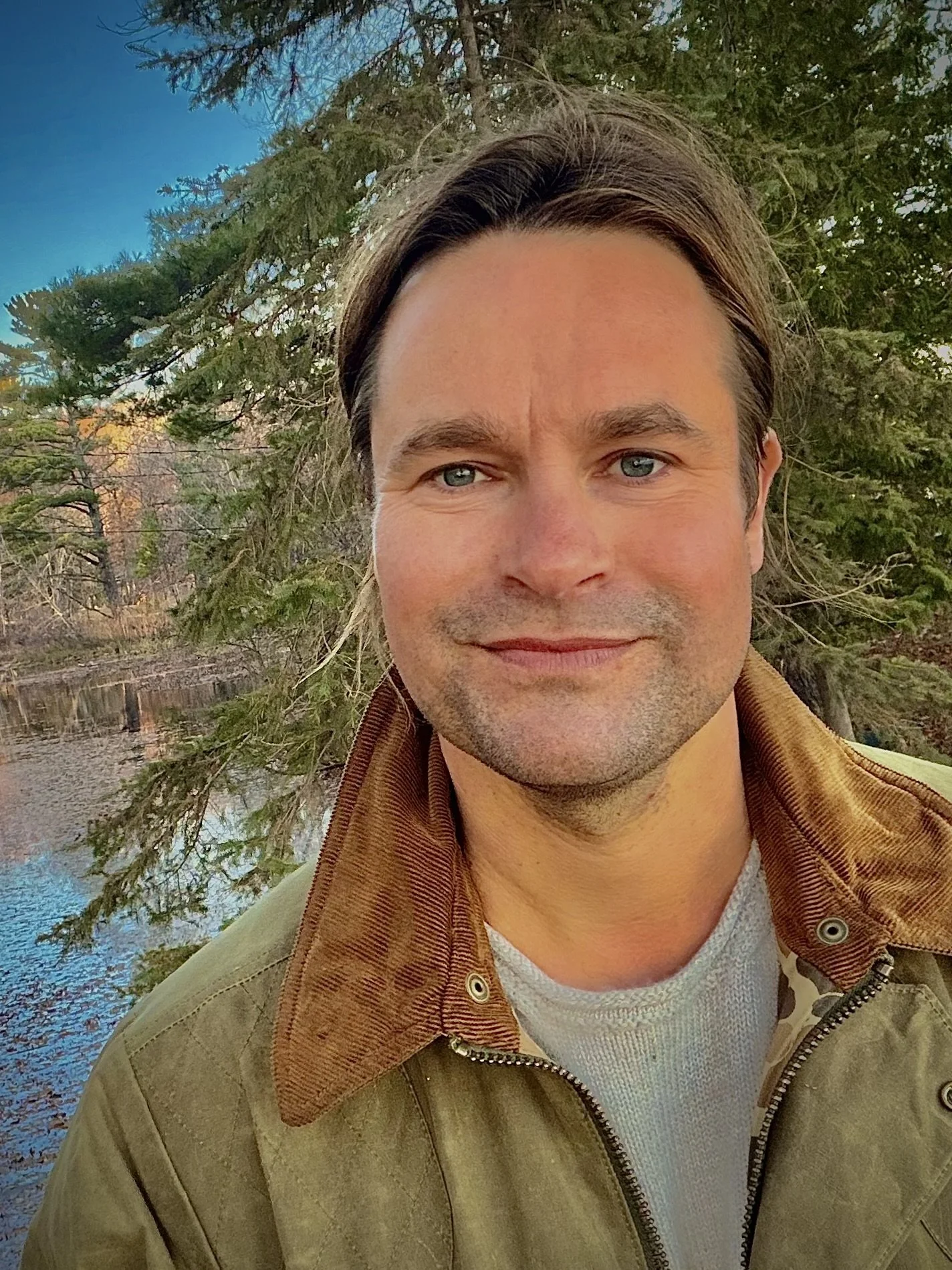
Daniel Cooperrider is a writer, ecotheologian, and pastor in the United Church of Christ. He is the author of Speak with the Earth and It Will Teach You, Gold Winner in the 2023 Nautilus Book Awards, and Live Each Season as It Passes. Cooperrider and family are based on the edge of the driftless region of Madison, WI.