Sanctified Imagination: Writer Amy Muia
in Conversation with Christopher Honey
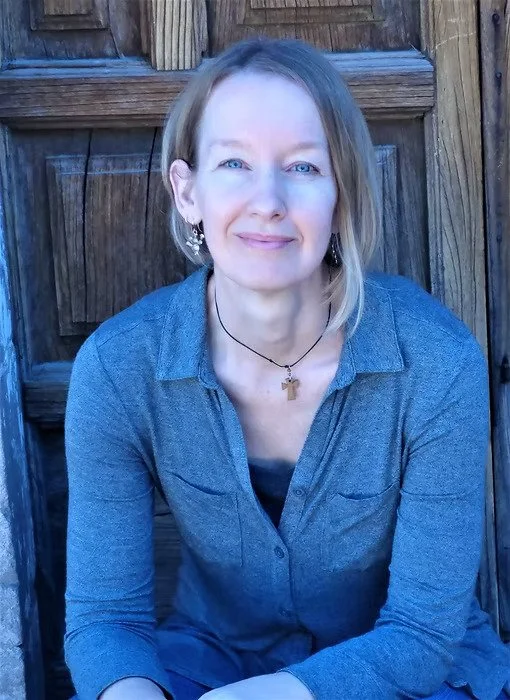
A. Muia is the winner of the Flannery O’Connor Award for her novel A Desert Between Two Seas (University of Georgia Press), a 2026 Top Pick for the Southwest Books of the Year and a finalist for the Iowa Short Fiction Award. Her stories and articles have appeared in Chicago Review, Grist, Image Journal, The Orison Anthology, Water~Stone Review, West Branch, AWP’s The Writer’s Chronicle, and other journals across the United States. She is a frequent speaker and workshop facilitator, and leads writing circles with youth in juvenile detention through the nonprofit Underground Writing. Find out more at www.amuia.net.
The following transcript has been edited for length and clarity. Click above to listen to this interview in full.
Christopher Honey: How does your own faith and your faith journey connect to the role of faith and spirituality, and the journeys these characters take in the book?
Amy Muia: Faith has been such a big part of my life since I was a child, and I always had a tangible sense of Christ with me. I lived in a real small Midwestern town, and there was an alleyway that ran behind everybody’s houses. I used to walk home from school along that alley through the fields, and I had a clear sense of Christ with me. I would just talk with Jesus as we walked along. So, for me, in my young life, prayer was a kind of imagining. I wouldn’t say [it was] making things up, but using my holy imagination to see in a new way. Christ is with us all the time, and so I would use the sanctified imagination, the eyes of my heart, to see that Christ was with me.
Somehow prayer and imagining got mixed up in a beautiful way, and I think that really translated into my own writing practices. I don’t set out to write to a theme. In fact, I think the worst fiction is the kind of fiction that tries to teach, or argue, or persuade the reader of something instead of just being committed to truth and how people are, how the world is, and what we see and how we observe human beings as they think and feel and do.
Later, in [Desert Between Two Seas], that commitment to truth really also manifests itself in how I write about the Baja California landscape and what grows there. I start with what I can see with my human eye. I think if we’re faithful to what’s true, then themes will naturally rise from that. So there’s a particular kind of faithfulness just to the details themselves.
I heard somebody say one time that we need to go in fear of abstractions, and I think what that person was talking about is we need to stay with the particular. I can’t start out writing to a theme, but those themes might naturally arise. For example, in my own novel-writing about a priest who lives in a particular kind of landscape, that priest is surrounded by people who behave as real people do, and he behaves as real people do. He does good things and he does bad things, and he has mixed motivations. Then theme naturally arises out of that. And so, themes of faith, they enter the work, I guess because I’m the one that’s doing the writing, and faith is such an important part of my life.
But I find that in my own writing, it kind of comes in disguise, and Christ surprises me by showing up in certain places in certain ways in the writing, in ways that I didn’t expect. And I think it’s true of our own scripture. God often did come in disguise. God came in a burning bush. God came as a fourth man in a fiery furnace. Christ came as a baby. No one was expecting the Messiah to come as a baby on the road to Emmaus. It’s just a man walking along with the disciples, and they don’t recognize that it’s Christ. And so, Christ often arises in fiction, surprising me too. That’s some of the sneaky ways that that faith comes into the work.
CH: You used a wonderful phrase that I’d love to dive into more: “the sanctified imagination.” What an amazing phrase! I’d love to hear you talk about what that means.
AM: I took so many trips to Baja California, Mexico, and I traveled with a retired conservationist. We traveled together, and it was like faith and science traveling together. He would point out things to me that I never would have noticed, like what is native and what’s non-native, and why that landform is shaped in that way. What are the things under our feet that we’re accidentally crushing as we walk along and we don’t even realize that we are.
When I was there, I was taking tons and tons and tons of notes about the landscape. But it wasn’t until I came home back to Washington State, where I live, that I could really conceive of the stories. And that’s where I would take the facts of a place, and then—in my sanctified imagination, it’s like my holy eyes, the eyes of my heart—I would imagine who would be living in that place and what kinds of things would happen there. And again, it always starts with landscape for me, and then characters arise out of that landscape, and then themes arise out of those people that are interacting with those landscapes.
I would consider my novel part of that tradition of literature of place, and that’s different than setting. There’s nothing wrong with writing setting; it can be done very well with very particular details. But setting to me is kind of like there’s a curtain or there’s a backdrop. It’s like in the old-time movies when they would paint a backdrop behind the characters, and then the characters would act out their scenes in front of that backdrop but not really ever interact with that backdrop in any way. I think we live our lives a lot like that today. We act around our landscapes but often don’t interact with our landscapes, either because we’re just very busy and we’re very rushed, and we live now even more than ever in a virtual world, or because we have a theology that all of the natural world is passing away, so maybe we don’t care about it as much as we should, because we imagine out of our theology that it’s disappearing, and that it will be gone, and that we’ll all go to heaven, and we’ll go away from this place.
Those realities of our theology and of our busy world can make us not attend to the landscape, or even see it as sacred. Years ago, I attended a writing workshop about writing the natural world with Scott Russell Sanders. He’s a very great essayist. He lives in Indiana, where I grew up actually. He said something that stuck with me. He said that we don’t love what we don’t consider kin, kin meaning family or relation. He said, if we don’t see ourselves as created from the same stuff as the natural world, then we don’t love the natural world. That workshop about writing the natural world helped me look upon the natural world in such a different way, and it helped me see even more how landscape can be a character, how it’s not just a static backdrop, but it’s actually something that has agency. It affects and influences the people that are around it, and in it, and on it, and actually part of it. Themes naturally will begin to arise from that, if we just attend to landscape as a living, breathing entity. The characters are not set apart from that, but they’re part of it.
Let me give you just one example. I’m not very good at titles, and I struggled to find a title for the novel itself, and then I thought, well, what if I just tried to describe what the Baja California Peninsula is? And I thought, well, it’s a long, skinny desert between two bodies of water. So there’s the Pacific on one side, and then the Sea of Cortez on the other side. I thought, yeah, it’s a desert between two seas, and that just describes what it is, and that would be a decent title. But then I stopped, and I thought, wait a second; in a way, that is a metaphor for all of the characters that are within the book and us as human beings. It’s like I kept writing the same story over and over. I kept writing about people who had made mistakes and felt like they could never be forgiven for those mistakes, and that they weren’t worthy of love. And I thought, yeah, it’s like our hearts are like that, our hearts are deserts. We’re longing for love, we don’t feel like we deserve love, and yet we’re surrounded by love, and we can’t see it, and when it comes, we end up not recognizing it or even pushing it away. And so, again, starting with the natural world, it’s a desert between two seas, and this theme arises out of that. That describes a bit of my process and how the writing interacts with these sacred places, these sacred landscapes.
CH: You’re born and raised in Indiana, in the Midwest, and powerfully affected by these journeys around the Southwest, and you talk about actually exploring with a natural scientist, and the importance of this intimate interaction with the landscape. But you went back to Washington State where you live now, so you had to also step away to write this.
AM: I couldn’t really write the stories when I was sitting there in Baja California, Mexico. I had to come home and think with my imagination about what stood out to me the most.
Originally I’m from Santa Barbara, California. There’s a big Franciscan mission there, Mission Santa Barbara. Some people call it the Queen of the California missions. It’s large and beautiful. I lived in Santa Barbara until I was about seven years old, but we used to, as a family, hang out around the mission. Everybody does in Santa Barbara. Everybody goes up there and hangs out on the lawn. I remember feeling a bit in awe of that place. It’s such a large, grand, beautiful building. When I would go back to California to visit friends and family as a young adult, I started feeling really uncomfortable with that place too. You know, being in awe of the architecture, and how could these priests build such structures like that without the benefit of any modern equipment? How did they know how to do that? But at the same time, really struggling with the legacy of colonization and what the arrival of Spanish colonial powers connected with religion, what that meant for Native peoples. It meant a kind of enslavement; it meant a genocide. So many Native people died of diseases, and in Baja California too.
I always intended to write a novel about Mission Santa Barbara, but it was just really hard for me to picture, because when I would go there, there are tour buses, there are gift shops, there are areas that are roped off to the public. I ended up going to Baja California to serve as a translator for some dentists that were going down there to an orphanage. I noticed on the map that there was a little mission ruin right there nearby, and I had been studying, by this time, Spanish colonial history for a long time, but I had never really delved into the Baja California part of it. So I drove over with some friends to that little ruin, and all of a sudden my imagination was just really awakened in a new way, because [there were] no tour buses, no gift shops, just this little crumbling ruin of an adobe, and I could start to picture characters that were there.
So I shifted my focus and I began studying in earnest the history of the Baja California missions. I’m not Catholic myself, and so maybe it’s not quite fair for me to write about a faith tradition that’s not my own, but, in my own faith tradition, they were very heavily grounded in missional kinds of work, missionaries and evangelism, and so I had been wrestling with this for a while. What happens when the gospel comes with death in its robes? What happens when faith and the state and the military are all wrapped up into one? The Spanish missions are kind of like God and country when religion and the state have a particular aim, and that had devastating and terrible results for Native people. So, even though I’m not Catholic, some of these themes were things that I was already wrestling with, and that comes out throughout the book.
CH: When I think of the missions and the modern Western, Willa Cather and Cormac McCarthy come to mind. But in addition to winning the Flannery O’Connor Award, there’s also I think a relationship with her as someone who is spiritual and has a sense of place, but obviously a very different place. How do you view your relationship with Flannery O’Connor?
AM: The novel is a novel in linked stories, connected by place, by theme, by recurring characters. It won the Flannery O’Connor Award. It’s an award that honors the form of the short story because she was such an incredible short story writer and taught us all so much about how to write short stories. But I’d like to think that maybe I am related a little bit to Flannery O’Connor because she liked to write about very imperfect, sometimes even grotesque people who are always offered a moment of grace, and they sometimes can’t see it, and they sometimes don’t receive it. But I often also write about people who feel like they’ve made a lot of mistakes and have made mistakes, and they receive their moment of grace. It’s something that I wish maybe I could tell every reader before they pick up the book, because there are some stark and sad themes in the book for sure, and there are some stories that have a heaviness about them. But I wish I could tell each and every reader just to look for that moment of grace. And often it’s very small, it might be a tiny gesture, and often it comes through human beings. Which is often how I experience the grace of God, coming through other human beings.
My husband and I started a nonprofit of recovery houses, so we run eight recovery houses here in Skagit County, Washington, and I was a jail chaplain for many years. So for most of my adult life, I’ve been in ministerial relationships with people who have struggled with addiction and incarceration, and they’re people that do feel like they’ve made too many mistakes to really truly be loved, and even when they get into recovery, and even when they’re doing better, it’s so hard for them to receive love. I saw that actually in the churches too, people seem to just struggle with unconditional love. I remember one of our residents once said, “Unconditional love is creepy.” And what she’s talking about is how we’re used to, as human beings, being in transactional kinds of relationships, where I do something for you, and then you do something for me, or “I’m only really worthy of love if I’ve done something good, but when I do something that’s bad, love is withdrawn, love is taken away.” That’s often how we parent, that’s how we relate to one another, that’s how our school systems are set up. We’re rewarded for doing well, and we’re punished for doing bad.
I think I was trying to work out this theme in my mind without knowing that I was, and I was talking to a mentor of mine, Mary Lane Potter, and I said, “Mary, I keep writing the same story over and over about flawed human beings who struggle to receive love,” and she said, “It’s okay to write the same story over and over. It’s probably something you’re trying to figure out,” and I think that it was. Flannery O’Connor did the same thing, and someone told me one time, your book is like if Flannery O’Connor had written Death Comes for the Archbishop, and that to me is a tremendous compliment, and I think that’s pretty apt, I also write about unlikable people. I didn’t want to go with a Christian publisher, I really wanted just to be in the mainstream, even though my book is soaked with themes of faith. So I was really glad to land at the University of Georgia Press. But sometimes readers of faith, not all, but a few have said they didn’t like the book and they didn’t like the characters, and I think what they might be looking for is more of a hero’s journey. They want to see that yes, a person has weaknesses, but is generally very likable and someone that we can really root for, and then they have to overcome all these obstacles, and then they reach a point of no return, and the bridge falls away, and they have to make a decision, and they make one final big choice, and there’s a one final big struggle, and they come out victorious, and there’s a beautiful denouement.
I think in the Christian world, that’s often the testimonies that we hear: Once I was bad, and now I’m good. And I think our lives are just much too complex for that kind of simple testimony. And so it was important to me to write about a priest and other characters who make lots of mistakes. Yet, every person in the book, every character gets their moment of grace, every single one of them. And people have told me, man, some of your characters—they’re barely clinging to likability. I think, yeah, that’s probably true, but if we look into our own human hearts, I feel like I’m barely clinging to likability. And yet we are so deeply loved by God, and we could be deeply loved by human beings if we wouldn’t push each other away. So that’s me, and that’s Flannery. I guess we are related in that way, and it makes me feel very honored to be compared to her in any way.
CH: There is this wonderful character of the priest who, at least theoretically, has an understanding of God’s unconditional love and also a call to share that love. But of course, as you mentioned, this is a journey of failing redemption and of a connection to some terrible histories. Maybe you could talk a little bit about that, about these histories and what it means to fail to understand unconditional love.
AM: Love can heal us, but we often don’t see it. So in the history of the missions, I think the priests absolutely went with good intentions. The crown of Spain—they were there to take land and colonize and grab up the West Coast before Russia or England could get to it, so they definitely had colonial interests. The priests were wedded to that. They were working in conjunction, and it caused the death of many, many, many people and the suffering of many people, and yet they’re coming to share the good news of the gospel.
So how do we live in that tension? And maybe some people would say, you know, they didn’t know better, they only knew what they knew, so we can’t judge them by modern standards. But then you have voices like Bartolomé de las Casas, who was a priest a little before the California mission time, but of that colonial era, and he became awake to the injustices that were perpetrated upon the Native peoples. So there were voices even from that time saying, “This is wrong.” But in exploring those things through fiction, I felt like I was getting in touch with my own role as a harm-doer, and I don’t think that we can live in the world without being a harm-doer. I mean, we do harm to each other personally, but also just by living in society, by being consumers, the things we buy and eat and wear, we’re doing harm all the time. There were moments in the writing when I just felt such a heaviness about that, about my own role as a person who does harm to the earth and to others, and despite my best efforts, I can’t not do harm. Just because I’m alive in the world and in relationship with people, and living in a place where I can’t fully get away from consumerism and what that means to third-world peoples and inequity and all of that.
So there’s such a heaviness, and so I think I really could relate to this priestly figure. He does harm unintentionally, he causes the death of a boy by accident, and he didn’t mean to, but then he flees his call, he flees the mission, he flees his role as a priest, and he just wants to escape the territory. But he keeps getting drawn back in by people that want him to be that holy man, that sacred person who carries blessings and can confer blessings and sometimes he gives blessings without even meaning to. He can’t escape being a holy person, even though he’s committed this terrible crime, even though by accident. All of the people in the book are doing harm to one another, often without meaning to, and there’s a moment in the novel—which I won’t give away as a spoiler—but there’s a moment in the novel where Christ really comes overtly, and every time I read that scene, I still cry, even though I’m the one that wrote it, because I see myself in his shoes as a person who’s made a lot of mistakes and done things I really regret and feel so sad about, and yet Christ comes to him.
People ask me sometimes, “Is there a message that you hope that people carry away?” And again, I didn’t write it to teach a lesson or to teach a message, but this is what has naturally arisen is that love is all around us, and we can receive it, and we’re supposed to receive that love, no matter what we’ve done, and maybe that relates to my work as a jail chaplain.
I also, for the last number of years, have led writing workshops in juvenile detention, and I see how love is so healing, and in some ways, the kids in juvie can receive it better than adults. I don’t know what it is. Maybe as children we’re wired to receive love, then somehow life kind of beats that out of us, and we’re willing to take scraps when there’s this lavish banquet of love that’s offered to us through God, and also through human beings.
I remember this one particular boy in juvie. We read a poem, and I forget which poem it was, but it had something to do with good people, bad people, and this youth, this boy, turned to me and said, “Do you think of us as bad people?” And it was such a vulnerable moment, and that’s maybe the question that’s in all of our human hearts: Am I a bad person at my core? Am I uniquely and fatally flawed, unlike other people who seem to be good and have it together? And I told him, you know, I actually, I never look up what your crimes were, I said, because here we’re just writers, I’m a writer, you’re writers, we’re all writing together. So I don’t need to know whatever it is that you did. And maybe that’s a space of unconditional love, maybe we don’t need to know what we’ve done. But maybe we just need to look at each other as fellow human beings on the way, forgiven, loved, and on the journey together.
CH: I’m glad you brought up this work you do with juvenile detention, your work as a prison ministry, and so I have to ask about Underground Writing.
AM: Underground Writing is a nonprofit here in Skagit County that was started by poet Matt Malyon. Underground Writing takes writing and exploration into places where people don’t typically have a voice, and so there are different venues. One is juvenile detention; that’s the one I’ve been involved in mostly. They also do writing with immigrant youth. They’ve done writing workshops with people in the local jail, although that has been closed down since the pandemic and never reopened, which is really sad and really tragic. And also with people in addiction and recovery.
Essentially, it’s called Underground Writing, I guess, because it goes to places where people have typically been hidden. I have just been amazed at the beauty of the writing that comes out of those places, and especially people who maybe don’t have any history with writing, because I don’t think that they have the same worry about it being good as maybe those of us who have come up through places where we’ve studied writing, and we have a lot of blocks. We’re afraid it’s not going to be good when we sit down to the page, and that can inhibit us and make it maybe less good than it could be.
We also try to really get away from the notion that writers hide or code meaning and theme into the work, and then our job as readers is to decode or unearth the meaning that the writer has hidden there. That’s what I really grew up with in school, and the meaning that I was seeing there was never the meaning that the teacher said it was. So I didn’t really like literature, it felt like a chore and a task. When I was in graduate school, poet Scott Cairns asked the better question. Instead of asking “What does it mean?” we should be asking “What does it remind us of?” I love that question so much because I think we can approach scripture in the same way. We can come at it thinking, “What does it mean?” and we’re analyzing it in a very heady intellectual kind of way, instead of looking at it at least certain portions of it as literature. And so, what does this remind us of?
My own novel has lots of themes of faith, and I didn’t necessarily put it there on purpose. So, for example, there’s a donkey in the novel, and the donkey has a cross on its back in the form of brown fur shaped in a cross. So many people have asked me about that donkey, what does it mean? And is that a symbol of Christ? I have to disappoint them by saying, well, no, the donkey looks like that because that’s what donkeys look like. Donkeys, certain kinds of donkeys are gray and they have a dark cross on their back, and that’s what they look like, and that’s why he looks like that. But reader, make of it what you will, I mean, maybe it reminds you of something, and if it does, then you’re free to make that connection. What’s beautiful about that is that every time a reader picks up the book, something new is created between the text and the reader and me. Something new arises every time it’s read, because the reader will make their own connections out of their own memories.
CH: I think that’s a beautiful moment and some great variety of advice to bring this to an end. Amy, thank you so much for taking time to talk to us, and I hope that everybody will take a moment to pick up Desert Between Two Seas.
AM: Thank you so much. I enjoyed this conversation very much, and I look forward to interacting with any readers that want to reach out to me.